
Key points
- The court denied Gemini and the CFTC’s joint request for relief from their consent order.
- The $5 million penalty was already paid; the parties had agreed it would not be refunded.
- Changed enforcement priorities do not automatically remove existing court obligations.
PANTHER JOURNAL #023
Both sides wanted the door reopened. The judge kept it shut.
The Gemini CFTC settlement survived an unusual challenge: the regulator that brought the case joined the company in seeking relief. In an October 15 order, U.S. District Judge Alvin Hellerstein denied their motion.
The distinction for crypto readers is immediate. A change in an agency’s enforcement posture can matter enormously. It does not, by itself, erase a court judgment.
What survived the challenge
The court records a June 2, 2022 lawsuit alleging false or misleading statements during the CFTC’s review of a proposed Bitcoin futures contract. A January 6, 2025 consent order imposed a $5 million penalty and continuing relief. Gemini paid the penalty.
The Block’s October 16 reporting independently confirms the denial and the continuing injunction. This was not a new $5 million fine announced on October 15.
Nor was the challenge a route to a refund. In its May 27 statement, the CFTC said the parties had agreed the money would not be returned. That detail changes how the headline should be read: the stakes included the order’s continuing constraints, not a fresh cash payment.
Why the CFTC switched sides
The agency said its internal review found the complaint should not have been filed under current enforcement standards. It raised concerns about evidence, a whistleblower’s credibility and litigation tactics. Those are the CFTC’s stated conclusions—not findings Panther is independently making about individual officials.
The court dates the joint motion to May 28, a day after the agency’s announcement. The parties sought to vacate the consent order or, alternatively, its prospective provisions.
The judge treated the asserted change in policy differently from a change in the law. He also concluded that the account of regulatory pressure did not establish involuntary consent. The order points to Gemini’s representation by counsel and its decision to settle shortly before trial.
A settlement is not an expiring political promise
Panther’s assessment: the surprising part is not simply that a crypto company lost a motion. It is that agreement between the litigants did not settle the question for the court.
Three separate layers matter: the agency’s present priorities, the company’s obligations under an existing order and the court’s standard for reopening that order. Treating them as one thing makes political optimism look like legal finality.
The ruling also leaves room for the CFTC’s discretion over whether to seek enforcement under its current priorities. That is different from removing the order from the record.
This is not a fresh trial verdict resolving every disputed allegation. The motion concerned relief from an existing consent order. A reader should not turn its denial into claims the decision did not make.
What crypto users should watch
For customers and counterparties, the useful follow-up is a concrete filing: any appeal, revised court order or specific enforcement action. A friendlier speech or agency statement is not a substitute. This article does not assert that Gemini’s operations were halted or that customer assets are impaired.
The same habit helps distinguish different kinds of institutional decisions. Our MSCI index-screen report concerns benchmark eligibility, for example—not a regulatory ruling. Identifying who made a decision, what power they exercised and what it changes is more useful than labeling every development “regulatory clarity.”
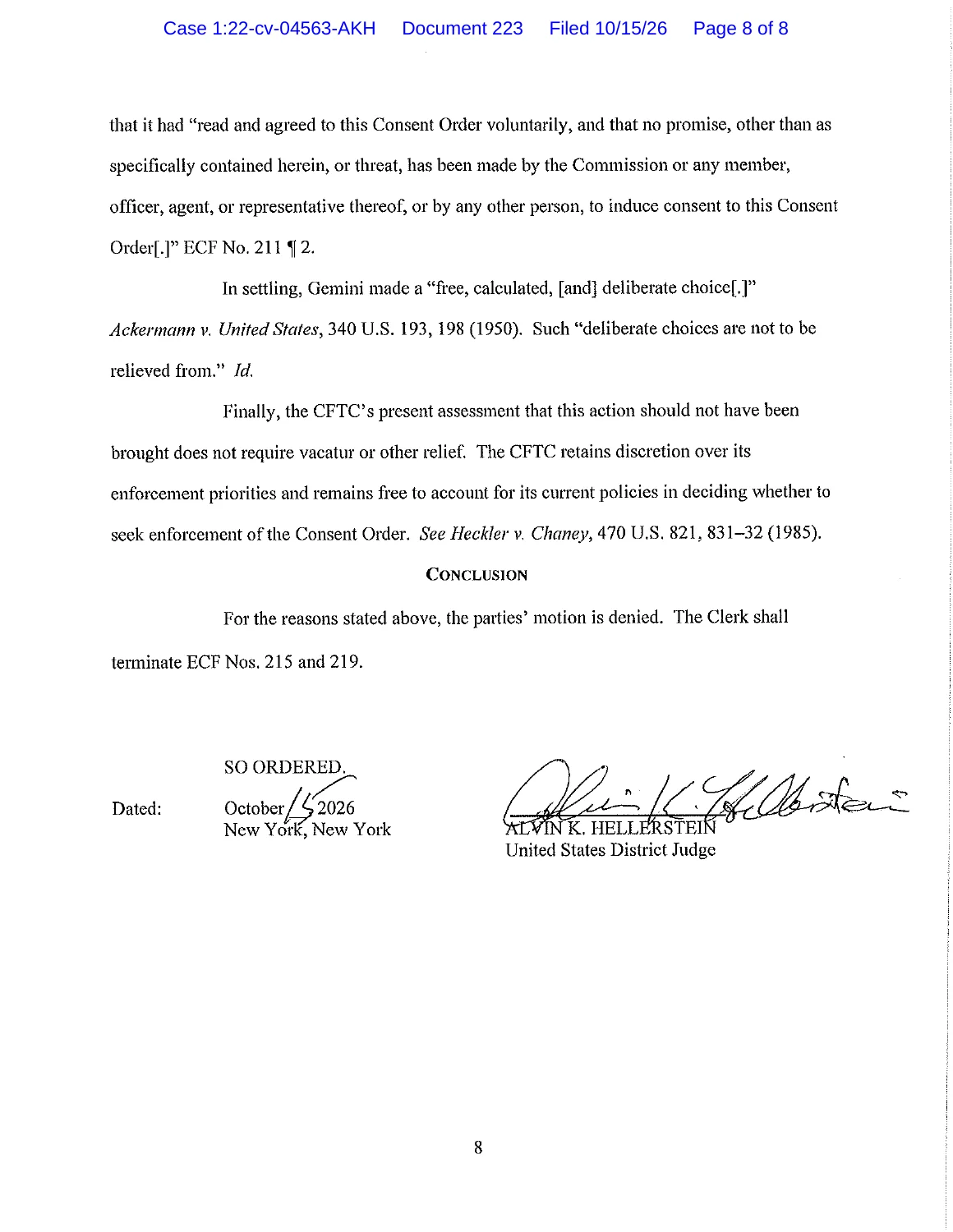
Source: U.S. District Court, S.D.N.Y., document 223, page 8, via CourtListener/RECAP. Authentic public court filing; full order linked above.
Panther Takeaway
A regulator can change its position while a company’s court obligations remain. Read the operative order, separate paid penalties from continuing restrictions and wait for actual legal changes before declaring a reset.
Sources and verification
- U.S. District Court, Southern District of New York, CFTC v. Gemini Trust Company, case 22-cv-4563, document 223, filed October 15, 2026. Primary order linked above; pages 1 and 6–8 checked against the reporting.
- CFTC release 9236-26, May 27, 2026. Primary statement explaining the agency’s position and the agreement against refunding the penalty.
- The Block, Danny Park, October 16, 2026, 01:44 EDT. Independent confirmation.
Cover: conceptual illustration. Supporting court page: authentic public filing, reproduced from CourtListener’s RECAP copy.
Responses
No responses yet. Start the conversation.
Panther Journal — The intelligence brief
Stay ahead of the story.
Free. New investigations delivered when published. Unsubscribe anytime.