Key points
- The ETH/USDC mechanism sets separate buy and sell fees that respond to recent pool-price movement.
- A temporary backrun-side fee means a lower permanent fee does not always mean a lower total charge.
- Governance can change fee logic and parameters; liquidity providers still need evidence of net results.
PANTHER JOURNAL #020
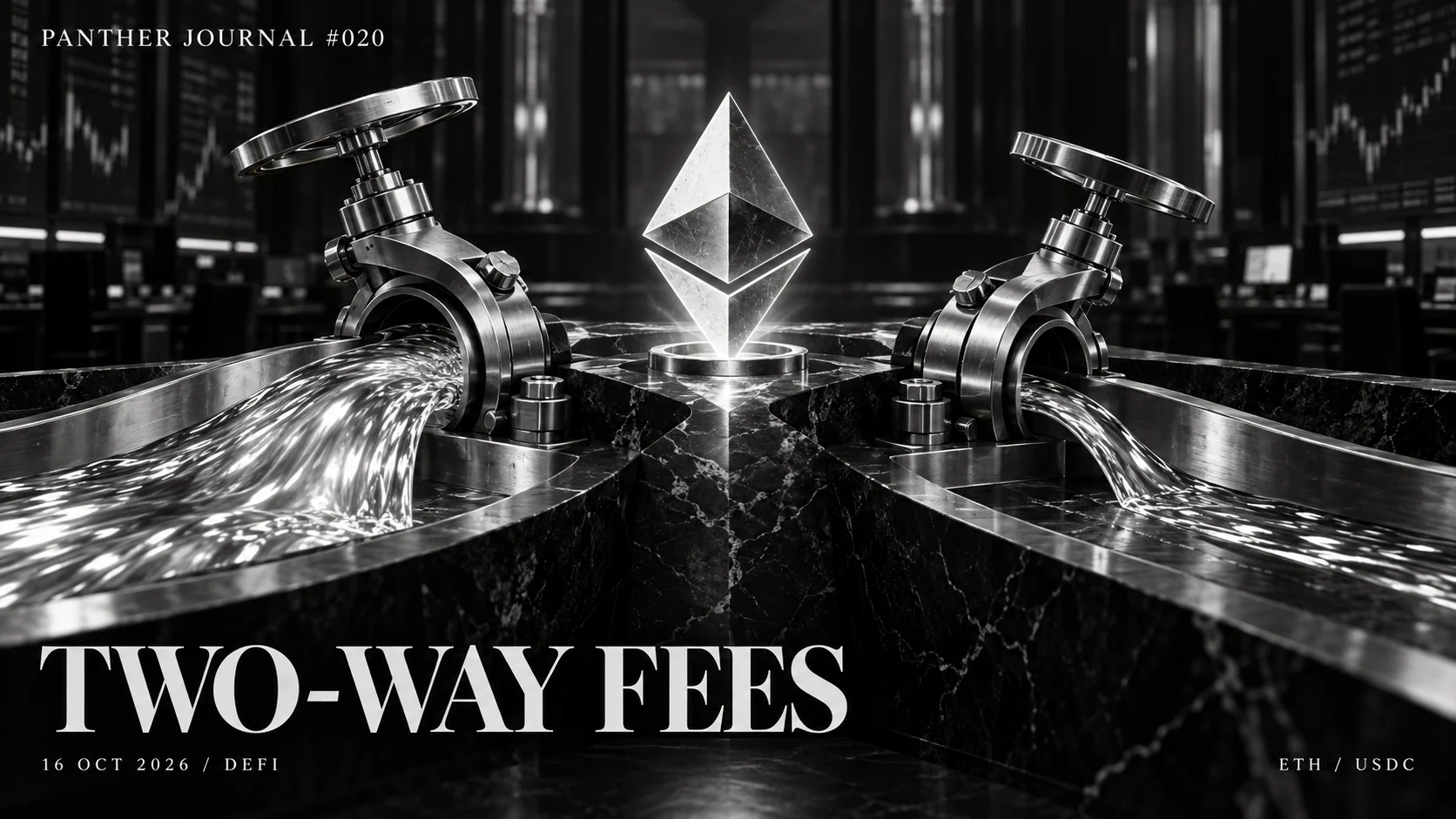
You buy Ether. A moment later, you look at selling it. The fee need not face you symmetrically. The Uniswap VolatilePair Hook makes trade direction part of the pricing mechanism in a new ETH/USDC pool on Ethereum.
Uniswap Labs announced the launch on October 14, 2026. This is a pool-specific mechanism built on Uniswap v4, rather than a claim that every Uniswap swap now follows one new fee schedule. The practical story is who pays when the market moves—and who gets to keep the value.
Uniswap VolatilePair Hook: fees follow direction
Labs describes separate buy and sell fees, recalculated on each swap using recent pool-price moves. After the pool price rises, the fee for buying ETH increases while the fee for selling it decreases; falling prices reverse that relationship.
The stated aim is to improve liquidity-provider economics when fast traders exploit a pool price that lags the wider market. That is the design argument, not a measured promise of higher returns for every depositor. Independent coverage by The Crypto Times on October 15 confirms the launch and describes the same directional mechanism.
The difference matters because “the fee” is no longer a sufficient description without asking which direction, which pool state and which moment. A quote obtained for one transaction should not be treated as a standing offer for its reverse.
A cheaper side can still pay an extra charge
There is another layer. The developer documentation on temporary fees describes an additional charge on the backrun side after a price move. A backrun is a transaction following an earlier move to capture the opportunity it leaves behind.
The mechanism calculates this temporary component at the first swap of a block; swaps on the backrun side pay it during that block. Separate configuration thresholds govern its components. So the direction whose permanent fee fell is not necessarily the direction with the lowest total charge at that instant.
Panther’s reading: compare the executable result, not a remembered fee tier. Consider a hypothetical round trip: you obtain a buy quote, another trade changes the pool, then you request a sell quote. Those are two different states. The second quote requires its own review, even if your token amount is unchanged. This example explains the mechanism; it is not a measurement of trading costs in the live pool.
Liquidity providers are buying into changing rules
Uniswap’s security documentation identifies a governance-controlled upgradeable proxy. Governance can change the implementation and fee configurations. The docs also say that fixed hook permissions prevent upgrades from blocking liquidity withdrawals or changing swap amounts through the disabled return-delta flags. These are the documented boundaries of the design, not a claim that every possible risk disappears.
The same page discloses limitations. A fee lookup is exact for the next swap under the same state, block and direction; later swaps can pay more as prices move. Price movement through ranges without liquidity can also affect subsequent fee calculations.
For an LP, those details belong beside the promise of retaining more value. A useful evaluation asks whether fees compensate for the inventory and execution risks actually taken over a comparable period. Gross fee income alone cannot settle that question.
For traders, this connects to Panther’s explanation of MEV and sandwich attacks: transaction order and the route used can matter alongside the asset selected.
Panther Takeaway
Read both directions. VolatilePair turns the fee into a response to market movement, with explicit rules and limitations. Traders need a current quote; liquidity providers need evidence about net results. A more responsive mechanism is a development worth understanding before treating it as an improvement already proved.
Sources and verification
Primary: Uniswap Labs’ October 14 launch post and the official developer pages linked above, reviewed October 16. Independent: The Crypto Times, October 15. Launch status is attributed to Labs and corroborating reporting; Panther did not execute a swap or independently benchmark LP returns.
Responses
No responses yet. Start the conversation.
Panther Journal — The intelligence brief
Stay ahead of the story.
Free. New investigations delivered when published. Unsubscribe anytime.