Key points
- Anthropic’s October 16 report reconstructs public NIST curve seeds; it does not recover Bitcoin wallet private keys.
- Panther reproduced the P-256 example exactly; that narrow check does not verify every curve or the reported model runtime.
- Bitcoin’s secp256k1 is different from P-256; unexplained selection details remain, and the finding is not a quantum-security result.
PANTHER JOURNAL #032
The lock did not open. The blueprint finally acquired a history.
The NIST curve seeds mystery has a reproducible answer, according to research published by Anthropic on October 16. For Bitcoin ($BTC) readers, the crucial distinction comes first: recovering the origin of public curve parameters is not recovering a wallet’s private key.
What Claude found in the NIST curve seeds
Anthropic’s report describes an internal research model reconstructing the generation of five NIST prime-curve seeds using an older C-library pseudorandom generator initialized from timestamps. The company says the initial discovery took under half an hour. That timing is its account, not Panther’s benchmark of the model.
The historical question was how those public starting values had been selected. It was not whether someone could read a secret recovery phrase from a blockchain. The word “seed” is doing two very different jobs in those sentences.
Cryptographer Filippo Valsorda independently reimplemented the algorithm in Go and confirmed the bounty claim. His October 16 account dates the submission to October 15 at 01:07:51 UTC. The evidence therefore extends beyond a model’s confident explanation: another implementation reproduces the result.
One exact match Panther checked
Panther reran the disclosed generator for the P-256 example: timestamp August 16, 1997, 01:52:34 UTC, candidate 1,842. The output matched the published 160-bit seed exactly:
C49D360886E704936A6678E1139D26B7819F7E90
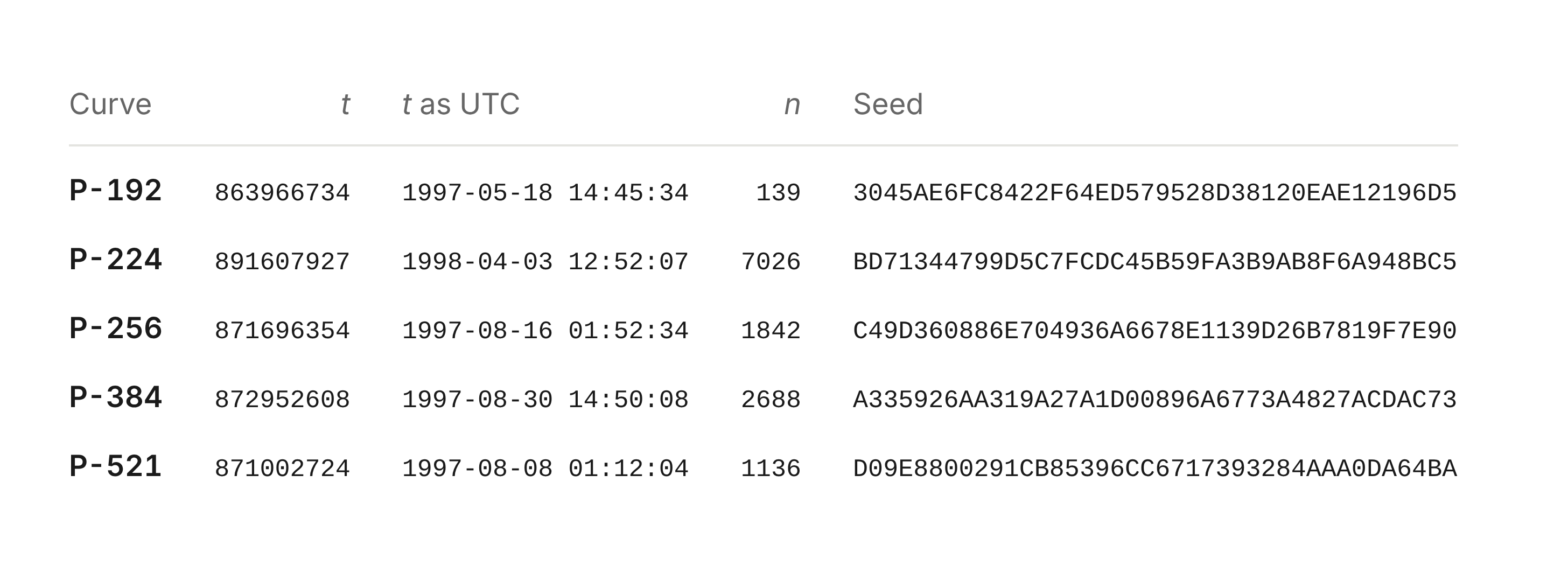
Source graphic: Anthropic, October 16, 2026, “Claude reveals ECDSA curve origins.” The table reports public curve parameters, not wallet secrets. Panther reproduced only the P-256 row.
That is a deliberately narrow verification. It checks the stated calculation for one public value. Panther did not rerun every curve search, reconstruct the model session or independently establish the researchers’ runtime.
The distinction is useful for evaluating AI research generally. A persuasive transcript is a claim. A published procedure that another person can execute provides a stronger way to check a particular result. Neither one makes every surrounding interpretation automatically true.
Bitcoin uses a different curve
Bitcoin’s BIP 340 specification identifies secp256k1 as the curve used for its Schnorr signature construction and describes Bitcoin’s earlier ECDSA use over that same curve. P-256 is a different curve.
Knowing where a public design parameter came from is also a different mathematical problem from deriving an unknown private key from its public key. The newly reconstructed recipe does not provide such a derivation. It does not supply a Bitcoin signing key or demonstrate an unauthorized transaction.
CoinDesk’s October 17 reporting independently places the finding in that Bitcoin context. Describing it as “AI cracked Bitcoin” would erase the difference between the objects being studied.
For holders, this result supplies no reason to enter a recovery phrase into a verification website. Panther’s recovery-phrase guide explains what changes when an actual wallet secret is exposed. This research concerns public parameters instead.
Confidence increased; questions remain
Anthropic explicitly says the finding is not a new cryptographic attack. It also identifies unresolved details, including why some viable candidates were skipped and how several base points were selected. Valsorda’s independent write-up likewise discusses unexplained selection criteria.
Those limits belong beside the discovery. Reproducing the output strengthens a historical explanation without proving that every design decision is now documented. Nor does it establish quantum resistance: a reconstruction of parameter selection is not a post-quantum security result.
The practical question for readers is precise: what did the demonstration recover? Here, it recovered a recipe for public numbers. Claims about broken signatures, exposed wallet secrets or a required emergency migration would need different evidence.
Panther Takeaway
AI helped make an old cryptographic claim reproducible. The reader’s advantage is keeping the achievement proportional to the proof.
The recipe was recovered. Your private key was not.
Sources and verification
- Anthropic, October 16, 2026: research account, reproduction code and stated limitations.
- Filippo Valsorda, October 16, 2026: independent implementation and bounty confirmation.
- Bitcoin BIP 340: primary specification for the Bitcoin curve distinction.
- CoinDesk, October 17, 2026: independent reporting.
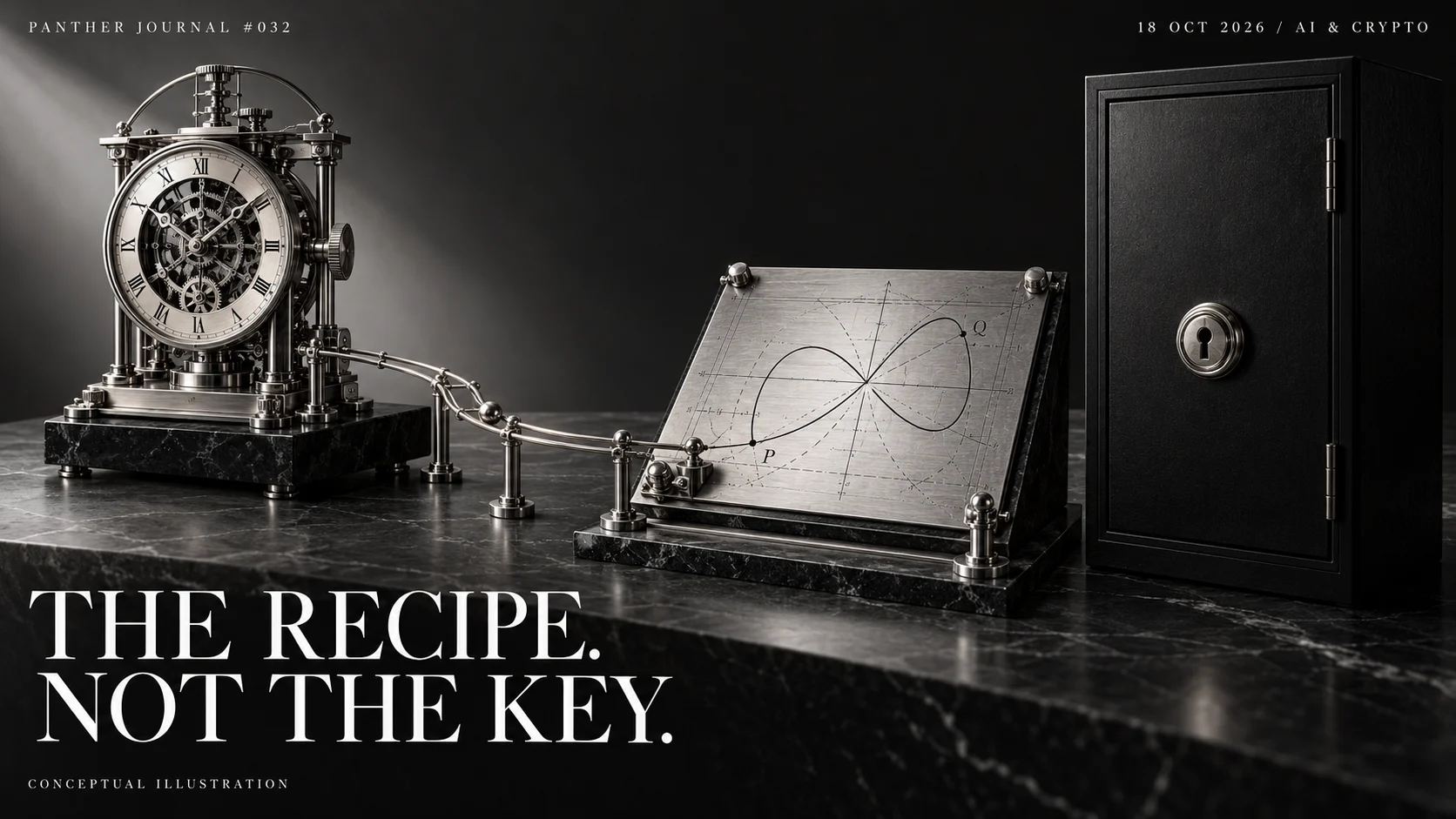
Verification: Panther reproduced the single P-256 example described above. Model performance and broader findings remain attributed. The cover is a conceptual illustration, not a screenshot of the research.
Responses
No responses yet. Start the conversation.
Panther Journal — The intelligence brief
Stay ahead of the story.
Free. New investigations delivered when published. Unsubscribe anytime.