Key points
- The recovery phrase is the wallet's keys in words. Anyone who has it can restore your wallet on any device or app; your PIN and device do not stop them.
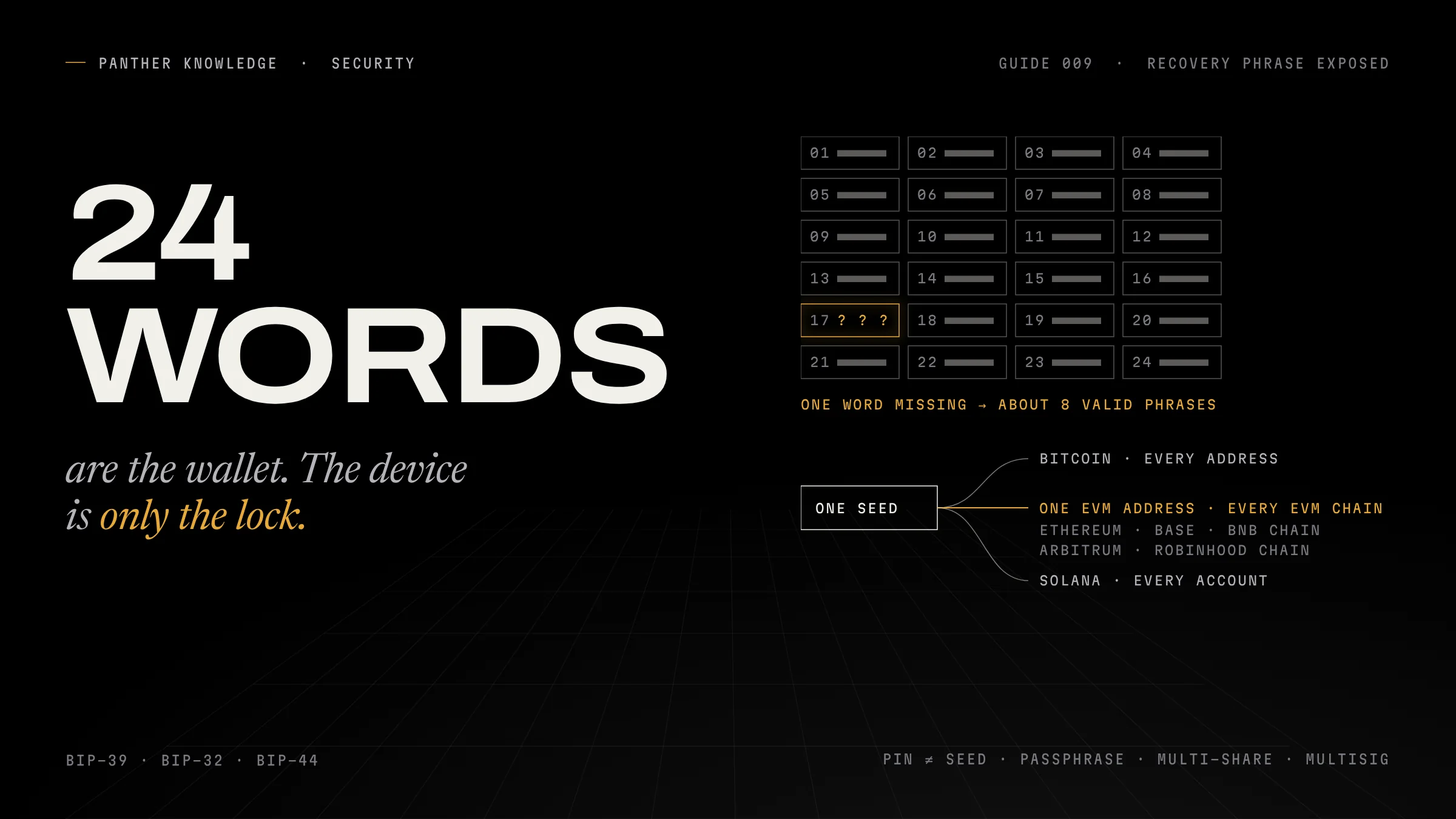
- One phrase covers every account it derived: all Bitcoin addresses, one address shared by every EVM chain including Robinhood Chain, and Solana accounts.
- Half a phrase is still a phrase: with one word missing, a 24-word phrase has about 8 valid candidates.
- Transfers are irreversible, and sweeper bots take anything that later lands in a compromised address within seconds.
- A passphrase, multi-share backup or multisig vault means one leaked phrase is not enough, at the cost of more to manage.
- If exposed: new wallet with a new phrase, move the largest balances first chain by chain, never reuse the old phrase, find and remove the leak.
A hardware wallet keeps your private keys inside a chip that never hands them to your computer. That protection has one deliberate exception: the recovery phrase, the 12 or 24 words you wrote down on setup. Those words are the keys, written in a form a human can copy. Ledger calls the phrase “the master key to your accounts.” MetaMask puts it more bluntly: “whoever controls the SRP controls the wallet.”
So the short answer is: if someone has your recovery phrase, they have your wallet, on every chain it touches, without needing your device, your PIN or your computer. This guide explains why, what an attacker can and cannot reach, the setups that survive a leaked phrase, how phrases actually get stolen, and what to do in the first hour if yours has been exposed.
Why the device cannot save you
The hardware wallet and the recovery phrase protect against different things.
| Device stolen, phrase safe | Phrase exposed, device safe | |
|---|---|---|
| Can the thief move your funds? | No. Ledger: “even if your Ledger signer is stolen, the thief can’t access your accounts.” | Yes. Trezor: “they can access your coins using a different device or wallet.” |
| Does your PIN help? | Yes. It “prevents anyone who physically obtains your Trezor device from using it.” | No. “Your PIN is independent of your wallet backup.” |
| What you do | Buy a new device and restore from the phrase | Move everything to a new phrase |
The PIN locks one physical device. The phrase can be typed into any device or any wallet app, which will then set its own new PIN. Ledger’s recovery page says it plainly: your phrase “lets you recover your accounts using any wallet, any device and any provider.” That is the feature that saves you if the device breaks, and the reason a stolen phrase is final.
What the phrase actually is
Most wallets follow three Bitcoin standards that the rest of the industry adopted.
BIP-39 turns 128 to 256 bits of random data into words. A checksum is added, the result is cut into 11-bit groups, and each group picks one word from a fixed list of 2,048. That gives 12 to 24 words, in steps of three. The words are then stretched into a 512-bit seed using 2,048 rounds of HMAC-SHA512, with an optional passphrase mixed in. “If a passphrase is not present, an empty string “” is used instead.”
BIP-32 grows “a tree of keypairs from a single seed.” Every address you have ever used is a branch of that tree, and “knowing an extended private key allows reconstruction of all descendant private keys.”
BIP-44 organises the branches by coin and account: “One master node (seed) can be used for unlimited number of independent cryptocoins.”
The consequence is that one phrase is not one wallet. It is every account, on every coin, that any app derived from it.
Half a phrase is still a phrase
Guessing a full phrase is hopeless: a 24-word phrase carries 256 bits of randomness. Guessing a missing word is not. Each word is one of 2,048, and the checksum rejects most wrong combinations. On BIP-39’s own arithmetic:
| Phrase length | Checksum bits | Valid candidates if 1 word is missing | If 2 are missing |
|---|---|---|---|
| 12 words | 4 | about 128 | about 262,000 |
| 24 words | 8 | about 8 | about 16,000 |
A computer checks those in seconds. A photo with one word cropped out, or a phrase written across two cards with one card lost to a thief, should be treated as fully exposed.
What the attacker can reach
| Network | What a stolen phrase exposes |
|---|---|
| Bitcoin | Every address the wallet derived, and every unspent output on them |
| Ethereum and EVM chains | The same address on every EVM network. Trezor: “they all share the same addresses in your wallet.” That covers Ethereum, Base, BNB Chain, Arbitrum and Robinhood Chain, which is fully EVM-compatible: tokens, NFTs, and any DeFi position the address controls |
| Solana | Every account the wallet derived; Phantom: “anyone who has it can access your funds” |
| Everything else in the tree | Any other coin or account your wallets created from the same seed |
With the phrase, an attacker can also sign anything you could: token approvals, permits, contract calls. They can see your full balance and history across chains before deciding what to take.
And what they take does not come back. “A Bitcoin transaction cannot be reversed, it can only be refunded by the person receiving the funds.” “A transaction sent on Ethereum is irreversible.”
Sweeper bots
Attackers rarely drain a wallet once and walk away. MetaMask describes sweeper bots as “automated scripts that malicious actors deploy”: “As soon as a bot sees an incoming transfer of value, it initiates a second transaction” sending it on to the attacker. “Even if there is no ETH in the account, an attacker may fund it temporarily in order to cover gas fees.” A compromised address stays compromised: anything that lands in it later, an airdrop, a refund, a payment, can be taken within seconds.
What the phrase alone cannot reach
Some setups are built so that one leaked phrase is not enough.
| Setup | If one phrase leaks | The trade-off |
|---|---|---|
| Single phrase (the default) | Everything is exposed | Simple |
| Phrase + passphrase (“25th word”) | Ledger: “If they only have your 24 words, they can only access your regular accounts.” The passphrase opens “a separate set of accounts with brand-new addresses” | Lose the passphrase and those funds are gone: Ledger and Trezor do not store it. One wrong character opens a different, empty wallet |
| Multi-share backup (Trezor, SLIP-39) | “Individual shares do not leak any information about the shared secret”; you need the threshold of shares to recover | More pieces to store, in more places |
| Multisig vault (Safe, Casa, Unchained) | Safe: “even in case an attacker gets hold of 1 account, they cannot move funds” with a threshold of 2 | When a key is compromised you still have to rotate it and move funds to a new vault |
| Smart account with recovery keys (account abstraction) | “Backup keys can be added to a wallet, enabling key replacement if the primary key is compromised” | Depends on the wallet’s contract and who holds the backup keys |
A passphrase protects you only if it is not stored with the phrase. Written on the same card, it is just a 25th word in the attacker’s hands.
There are also backup services that hold your phrase for you in pieces. Ledger Recover, an optional paid service, splits an encrypted copy into three pieces stored by three independent companies in three countries, and checks your identity with a government ID before it will restore. Whether that trade-off suits you is your call; it is a different model from keeping the only copy yourself.
How phrases actually get stolen
Brute force is not the risk. People are. Every case below is documented:
Leaked customer data, then phishing. In July 2020 Ledger disclosed that about a million email addresses and, for 9,500 customers, more detailed data had been exposed. In December 2020 a list of about 272,000 customers’ names, postal addresses and phone numbers was published, and Ledger warned that “many of you have been targeted by e-mail and SMS phishing campaigns.” The fallout continued for years: in April 2025 Ledger confirmed physical letters telling recipients to “scan a QR code and enter their recovery phrase.”
Tampered devices. In 2023 Kaspersky analysed a counterfeit Trezor whose firmware replaced the random seed with “one of 20 pre-generated seed phrases” the sellers already knew. Kaspersky’s advice: “buy your wallet directly from the official vendor.” A genuine device never arrives with words already written down; the phrase is generated on the device when you set it up.
Photos of the phrase. In February 2025 Kaspersky found SparkCat, malware hidden in apps on Google Play and the App Store that would “scan image galleries and steal screenshots containing cryptocurrency wallet recovery phrases.” The infected Google Play apps had been downloaded more than 242,000 times. Trezor’s rule exists for this reason: “Never make a digital copy of your wallet backup (this includes Dropbox, email, encrypted folders, or photos).”
Fake support. Every major wallet says the same thing: Ledger “won’t ever ask you for these words,” Trezor “will never ask you for your wallet backup, even if you are speaking with our customer support,” and MetaMask, Phantom and Solflare say the same. Anyone who asks is the attack.
Force. Chainalysis reports that “wrench attacks”, physical violence or coercion against holders, “show correlation with bitcoin price movements.”
How common is it
Chainalysis counted about 158,000 crypto theft incidents in 2025, nearly triple the 54,000 of 2022, and at least 80,000 unique victims, up from 40,000. By Chainalysis’s lower-bound estimate, compromises of personal wallets accounted for 20% of all value stolen in 2025, down from 44% in 2024.
If your phrase has been exposed: the first hour
Trezor’s guidance starts with the right assumption: if you think the phrase may be compromised, “you should assume that is the case and move your funds elsewhere immediately.” Speed matters because “doing the steps promptly and sequentially minimizes the window during which stolen funds could be drained.”
- Create a new wallet with a new phrase, on a device you trust. Not a new account on the old phrase: MetaMask warns, “Do not create additional accounts in your now-compromised Secret Recovery Phrase.” Changing the PIN does nothing. If you have only one hardware wallet, Trezor describes two routes: park the funds in a temporary third-party wallet, wipe the device and set it up with a new backup, then move them back; or create the new backup first, note its receiving address, restore the old backup and send everything straight to the new wallet.
- Move what can be moved, largest first. Go chain by chain, starting where the most value sits. Every EVM network shares one address but holds a separate balance, so check each one. Each network needs its own gas: ETH on Ethereum, Base, Arbitrum and Robinhood Chain, BNB on BNB Chain, SOL on Solana.
- Watch for a sweeper. If funds you send in for gas vanish within seconds, a bot is active. Do not keep topping it up. Positions that cannot be moved instantly, such as staked or vesting tokens, may need specialist help.
- Retire the old phrase for good. “Consider your old wallet backup compromised – do not use it again.” Do not send anything to its addresses, and update anyone who pays you there.
- Find the leak. Delete photos, screenshots, notes, cloud copies and password-manager entries of the phrase; check the devices that held them for malware. If it was a device you did not buy from the manufacturer, replace it.
- Expect the follow-up. Victims are targeted again by people offering to recover funds or posing as support. No wallet company will ask for your new phrase.
Checklist: keeping the phrase from leaking
| Rule | Why |
|---|---|
| Write it on paper or metal, never in a photo, file, email or cloud | Malware scans galleries; cloud accounts get breached |
| Never type it into a website, app or form | No legitimate service asks for it except when you restore your own wallet on your own device |
| Buy hardware only from the manufacturer | Tampered devices can ship with a known seed |
| Store copies in separate, secure places | A single copy can be lost; a copy everyone can reach can be stolen |
| Consider a passphrase, multi-share backup or multisig for larger amounts | So one leaked phrase is not enough |
| Keep the passphrase somewhere other than the phrase | Together they are one secret |
| Treat any request for the words as an attack | Ledger, Trezor, MetaMask, Phantom and Solflare never ask |
Sources
- 01BIP-39: Mnemonic code for generating deterministic keys · Bitcoin BIPsgithub.com/bitcoin/bips/blob/master/bip-0039.mediawiki
- 02BIP-32: Hierarchical deterministic wallets · Bitcoin BIPsgithub.com/bitcoin/bips/blob/master/bip-0032.mediawiki
- 03BIP-44: Multi-account hierarchy for deterministic wallets · Bitcoin BIPsgithub.com/bitcoin/bips/blob/master/bip-0044.mediawiki
- 04What happens if I lose my Ledger? · Ledger Academyledger.com/academy/what-happens-if-i-lose-my-ledger
- 05Why the 24-word recovery phrase · Ledger Academywww.ledger.com/academy/enter-the-trust-zone/why-the-twenty-four-words-phrase
- 06Passphrase: an advanced security feature · Ledger Academywww.ledger.com/academy/passphrase-an-advanced-security-feature
- 07How to use a wallet backup · Trezortrezor.io/learn/a/how-to-use-a-wallet-backup
- 08What is Shamir backup · Trezortrezor.io/learn/a/what-is-shamir-backup
- 09Move crypto to a wallet with a new seed · Trezortrezor.io/learn/a/move-crypto-to-a-wallet-with-a-new-seed
- 10PIN protection on Trezor devices · Trezortrezor.io/guides/trezor-devices/trezor-fundamentals/pin-protection-on-trezor-devices
- 11Choosing the right network (same address on EVM chains) · Trezortrezor.io/guides/sending-receiving-staking-funds/moving-funds-from-exchanges/how-to-choose-the-right-network-when-withdrawing-from-or-sending-to-trezor
- 12Secret Recovery Phrase, password and private keys · MetaMask Supportsupport.metamask.io/start/user-guide-secret-recovery-phrase-password-and-private-keys/
- 13Fighting back against sweeper bots · MetaMask Supportsupport.metamask.io/stay-safe/protect-yourself/fighting-back-against-sweeper-bots/
- 14How to create a new wallet (recovery phrase) · Phantomphantom.com/learn/guides/how-to-create-a-new-wallet
- 15Things you need to know (irreversible transactions) · Bitcoin.orgbitcoin.org/en/you-need-to-know
- 16Ethereum security and scam prevention · ethereum.orgethereum.org/en/security/
- 17What Safe setup should I use? · Safe Helphelp.safe.global/articles/1038062742-what-safe-setup-should-i-use
- 18Account abstraction · ethereum.orgethereum.org/en/roadmap/account-abstraction/
- 19Addressing the July 2020 e-commerce and marketing data breach · Ledgerwww.ledger.com/addressing-the-july-2020-e-commerce-and-marketing-data-breach
- 20Message from Ledger's CEO on the data leak (December 2020) · Ledgerwww.ledger.com/message-ledgers-ceo-data-leak
- 21Ledger confirms physical scam letters requesting seed phrases · The Blockwww.theblock.co/post/352479/ledger-confirms-physical-scam-letters-requesting-seed-phrase
- 22Fake Trezor hardware wallet with pre-generated seeds · Kasperskywww.kaspersky.com/blog/fake-trezor-hardware-crypto-wallet/48155/
- 23SparkCat: crypto-stealing trojan in App Store and Google Play · Kasperskykaspersky.com/about/press-releases/kaspersky-discovers-new-crypto-stealing-trojan-in-appstore-and-google-play
- 24Crypto hacking and stolen funds, 2025 · Chainalysiswww.chainalysis.com/blog/crypto-hacking-stolen-funds-2026/
- 252025 crypto crime mid-year update (wrench attacks) · Chainalysiswww.chainalysis.com/blog/2025-crypto-crime-mid-year-update/
Responses
No responses yet. Start the conversation.
Panther Journal — The intelligence brief
Stay ahead of the story.
Free. New investigations delivered when published. Unsubscribe anytime.