

Key points
- Solstice is scheduled for October 19 at 12:59:30 UTC; Lotus operators must prepare before epoch 6,470,279.
- Service-reward increases are gated by payment volume. Incentives are not proof of repeat customer demand.
- The vesting-related supply-growth estimate is separate from Solstice’s block-reward distribution changes.
PANTHER JOURNAL #035
A rack of storage is not a queue of customers. Filecoin’s next economic test is whether it can turn one into the other.
The Filecoin Solstice upgrade is scheduled for October 19 at 12:59:30 UTC, according to the network’s official status page. For Filecoin ($FIL) operators, that is an immediate upgrade deadline. For holders, the more consequential question is what the new reward system will count as economic activity.
This is a pre-activation analysis. A scheduled epoch is not confirmation that the upgrade has completed successfully.
Filecoin Solstice upgrade: rewards follow a new test
The accepted FIP-0118 specification separates block rewards into consensus, service and burn streams. Registered service orchestrators receive allocations linked to onchain service volume. The service weight begins at 5%; after a bootstrap quarter, increases of five percentage points depend on meeting payment-volume targets. The consensus weight follows a published decline from 95% toward 50% over roughly nine quarters. The residual is burned.
That is not an unconditional promise to give service businesses more every quarter. If the volume gate fails, their weight does not step up. Nor is a larger nominal service allocation identical to customer revenue: one is a protocol incentive, the other is what a customer pays.
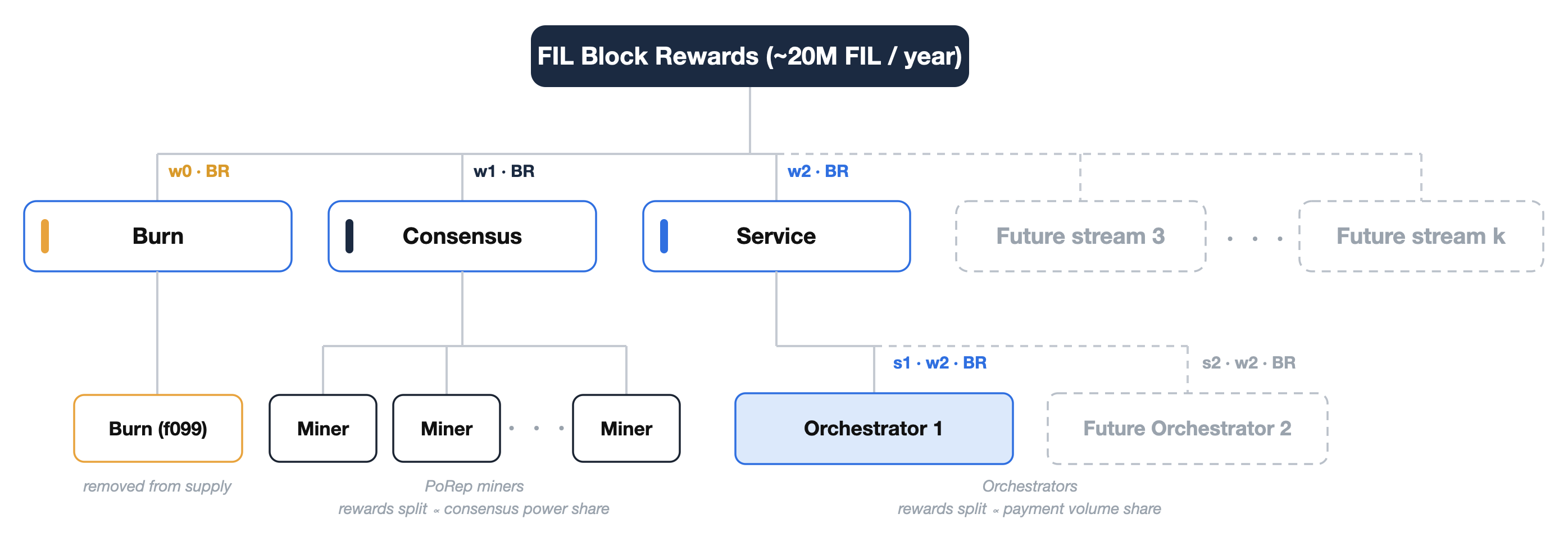
Source graphic: Filecoin FIP-0118 contributors, Figure 1. The diagram’s approximately 20M FIL/year label is indicative, not a fixed issuance forecast. Dashed boxes represent possible future streams and orchestrators, not confirmed participants.
The proposal also removes content-based quality distinctions for newly onboarded sectors: new sectors receive maximum quality-adjusted power regardless of content. That makes the distinction between storage capacity and paid service activity especially important.
Why the paying customer matters
The incentive change attempts to reward a different kind of success. Capacity answers whether the network can supply storage. Payment activity asks whether someone is purchasing a service through the measured rails. Neither question should disappear into a single “adoption” headline.
The constructive case is straightforward: businesses that acquire and retain customers could gain a clearer path to protocol rewards. A network can use that support to encourage services that would otherwise struggle to establish themselves.
The counterargument is equally important. Subsidies can attract activity because the subsidy exists. Payment volume alone does not prove repeat demand, customer independence or a business that can survive with less support. Panther’s inference is that the quality of the customer base, not just the reported volume, will determine whether this change improves the economy beneath the token.
Useful follow-up evidence would include repeat payments, customer retention, the share of activity concentrated among a few orchestrators, and how much service revenue remains when incentives are separated out. Those are evaluation questions, not outcomes established by the scheduled upgrade.
The vesting story is separate
Filecoin’s October ecosystem update also discusses the end of Protocol Labs and Filecoin Foundation allocation vesting. It cites modeling of roughly 75% lower daily new FIL entering circulation after that change.
Do not turn that modeling claim into a 75% cut to the block-reward schedule or a guaranteed reduction in selling. Ending an unlock stream changes supply availability. Solstice changes reward distribution. Demand and holders’ decisions about existing balances remain separate.
TokenPost’s independent reporting likewise distinguishes the vesting development from the reward redesign. Its account supports the scheduled date; it does not establish a completed mainnet migration or a future token price.
Panther’s market cap, liquidity and FDV guide explains why token-supply measures should not be mistaken for the money available to buy or sell an asset.
What operators must check now
The final Lotus v1.37.0 release notes call the mainnet update mandatory before epoch 6,470,279. They also retire DataCap and verified-registry writes from network version 29 and introduce changes that can break older operator assumptions.
This is not just a new marketing label. Teams should review their exact client version, retired Fil+ workflows and API callers against the release notes. For example, the notes replace the old initial-pledge query path and warn that some F3 monitoring metric names may change. A running dashboard is not proof that its old query still measures the same thing.
The cited migration benchmark is hardware-specific, not a universal downtime promise. Follow official status and client guidance rather than treating the scheduled maintenance window as a guarantee for every deployment.
Panther Takeaway
Filecoin is changing how it rewards economic activity. The test is not whether the new rules sound more commercial. It is whether paying customers return when the incentive is no longer the whole attraction.
For operators: verify the upgrade. For holders: separate paid demand, protocol rewards and vesting. Three different mechanisms deserve three different checks.
Sources and verification
- Official Filecoin status: scheduled nv29 activation at epoch 6,470,279, October 19, 12:59:30 UTC. Schedule checked before publication; successful activation is not claimed.
- Accepted FIP-0118: reward streams, volume-gated increases, sector-quality changes and the credited source diagram.
- Final Lotus v1.37.0 release: operator deadline and compatibility warnings.
- Filecoin ecosystem update: project’s commercial rationale and attributed supply-growth modeling.
- TokenPost, October 16: independent reporting cross-check. Panther has not audited the code or verified future customer revenue; the economic tests above are analysis, not a price forecast.
Responses
No responses yet. Start the conversation.
Panther Journal — The intelligence brief
Stay ahead of the story.
Free. New investigations delivered when published. Unsubscribe anytime.