Key points
- What gets locked or burned is the receipt for pool liquidity: an ERC-20 LP token on v2-style pools, an NFT on Uniswap v3/v4, PancakeSwap v3 and Raydium CLMM.
- Burned means sent where nobody can move it. Locked means held in a time-lock contract that its owner can withdraw from at the unlock date.
- To verify, account for close to 100% of LP supply: dead address, known locker, or someone who can withdraw.
- "95% burned" can still leave the deployer able to pull 5% of the pool, and to add and remove new liquidity.
- On Solana, live mint or freeze authority can ruin a token whose liquidity is burned.
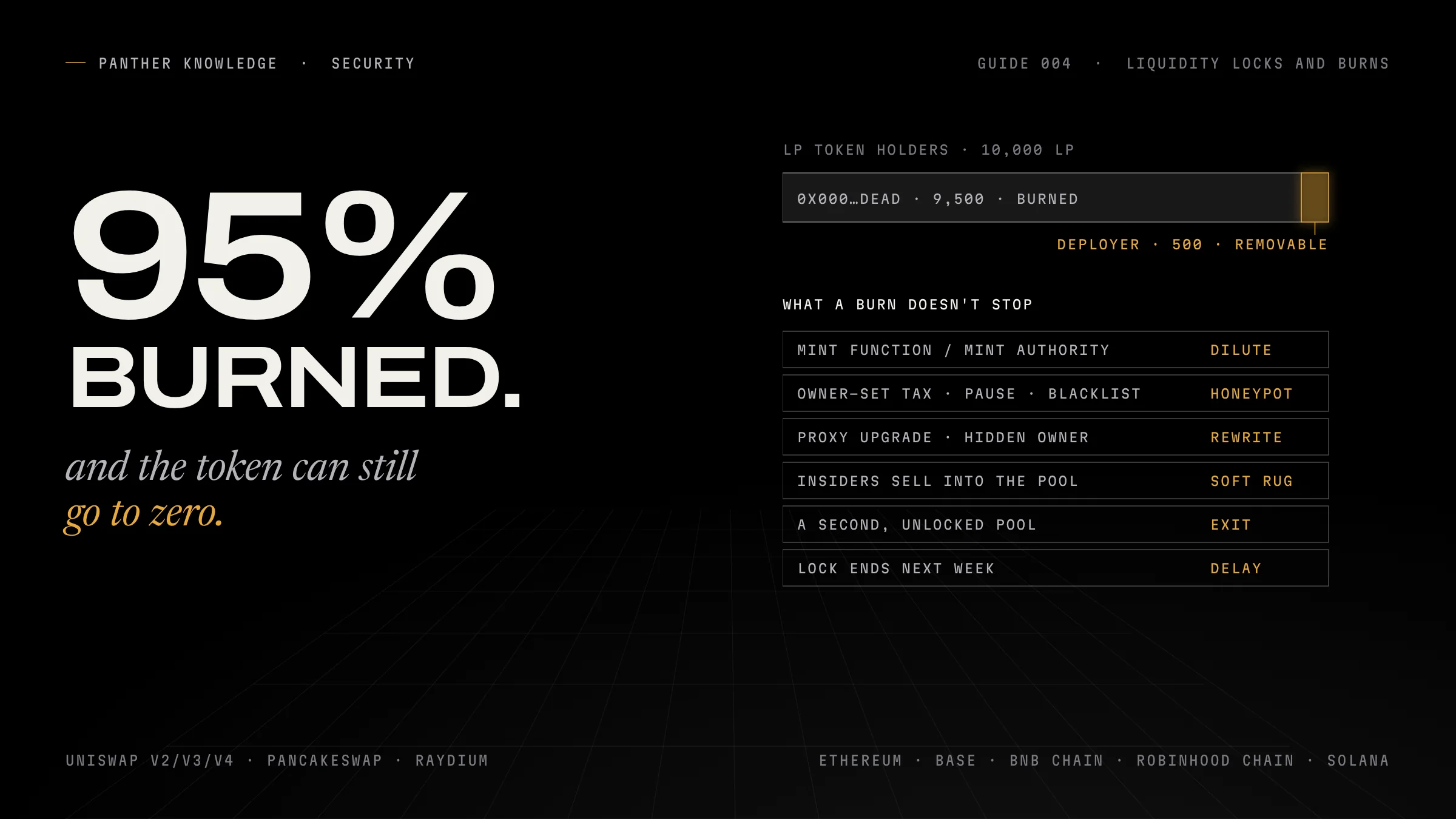
- Burns and locks do not stop minting, owner-set taxes, upgrades or insiders selling into the pool.
“Liquidity locked” and “LP burned” are the two phrases every new token puts in its first post. They are meant to answer one question: can the team pull the money out of the trading pool and leave holders with a token nobody can sell? Sometimes the claim is true, sometimes it is partly true, and sometimes it is true and irrelevant, because the team has another way out.
This guide shows how to check the claim yourself on Ethereum, Base, BNB Chain, Robinhood Chain and Solana, how the answer changes between Uniswap v2-style pools, concentrated-liquidity positions and Raydium, and what a lock or burn cannot protect you from.
What “liquidity” actually is
A new token usually trades in one decentralized-exchange pool, the token paired with ETH, BNB, SOL or a stablecoin. Whoever deposits the two assets receives a receipt for their share of the pool, and that receipt is what can be locked or burned.
Uniswap v2 and its forks (PancakeSwap v2, most launchpad pools). The receipt is an ERC-20 LP token. Uniswap’s docs: “tokens known as liquidity tokens are minted and sent to the provider’s address.” To withdraw, the holder burns LP tokens and receives their share of both assets. On the first deposit, a pool permanently burns a tiny amount (1,000 units of LP token) to avoid rounding problems; that is not the “burned liquidity” projects talk about.
Uniswap v3 and v4, PancakeSwap v3. There is no fungible LP token. Each position is an NFT: “liquidity positions are no longer fungible and are not represented as ERC20 tokens.” Whoever holds the NFT controls the position. Uniswap’s position manager can only burn the NFT once its liquidity is zero and fees are collected, so a v3 “burn” is really a transfer of the NFT to an address nobody controls, or into a locker.
Raydium (Solana). Standard and constant-product pools mint SPL LP tokens; concentrated-liquidity (CLMM) positions are NFTs. Raydium’s docs warn: “If an NFT is lost, sold, or burnt, the liquidity it represents will also be lost!”
So the first question is always: what is the receipt, and who holds it?
Burned versus locked
| Burned | Locked | |
|---|---|---|
| What happens | LP tokens or the position NFT are sent where nobody can ever move them | LP tokens or the NFT are deposited in a time-lock contract until a set date |
| Usual destination | The zero address 0x000…000 or the “dead” address 0x000…dEaD; on Solana, a Burn instruction that destroys the tokens |
A locker: UNCX, Team Finance, PinkLock, Mudra, Streamflow (Solana), and others |
| Reversible? | No | Yes, at the unlock date, by whoever owns the lock |
| What the team keeps | Nothing from that liquidity | The right to withdraw later, and often the trading fees in the meantime |
ethereum.org describes the zero address as one “frequently used as an address to remove tokens.” The dead address is used because some token contracts, including OpenZeppelin’s standard ERC-20, refuse transfers to the zero address. Nobody holds a private key for either.
On Solana, the token program’s docs are explicit: a Burn instruction “removes and discards tokens,” and “there is no other way to reduce supply on chain.”
Two products blur the line. Raydium’s Burn & Earn “permanently locks” positions while the original owner keeps a fee-claim NFT; Raydium says “technically, the NFT and LP tokens representing your principal position are locked, not burned.” It is still irreversible. PinkLock lets a lock owner “renounce” a lock, which “permanently transfers the ownership of that specific lock to a dead address”, turning a lock into a de facto burn.
How to check, step by step (EVM)
1. Find the pool. On DEX Screener or GeckoTerminal, open the token and copy the pair address. Check whether there is more than one pool; a burn on one pool says nothing about another.
2. Open the LP token on the explorer. For a v2-style pool the pair address is the LP token. On Etherscan, BaseScan, BscScan or Robinhood Chain’s explorers (RobinScan at robin.etherscan.io, or Blockscout), open it and go to the Holders tab.
3. Read who holds the supply. You want to account for close to 100% of LP tokens:
| Holder | What it means |
|---|---|
0x000…dEaD or 0x000…000 |
Burned |
| A known locker contract (tagged UNCX, Team Finance, PinkLock…) | Locked: open the lock to see the date and owner |
| The deployer or a team wallet | Removable at any time |
| An unlabelled contract | Find out what it is before trusting it |
Worked example. A pool holds $200,000 of ETH and the token, and 10,000 LP tokens exist. 9,500 sit at the dead address and 500 in the deployer’s wallet. The token page says “95% burned”, true. The deployer can still withdraw 5% of the pool at any moment, about $10,000 of the ETH side plus tokens, and nothing stops them adding more liquidity and withdrawing that later. “Burned” applies only to the LP tokens that were burned.
4. For v3 and v4 pools, find the NFT. The pool contract does not tell you who owns the liquidity. Find the position NFT (DEX analytics or the position manager’s Transfer events for that pool) and check its owner: a dead address, a locker, or a person.
5. Open the lock itself. On UNCX, use Explore and “input the pair address.” On Team Finance and PinkLock, the lock has a public page. Check:
- Unlock date. A lock that expires next week is a delay, not a commitment.
- Amount. What share of LP supply is locked? Compare it with step 3.
- Owner. The lock owner can withdraw at expiry, and on most lockers can transfer the lock to someone else. UNCX lets the owner relock, top up, split and transfer; PinkLock says “the owner address is the only one that can unlock or claim tokens from the lock.”
- Fees while locked. Team Finance and UNCX v3 let owners keep collecting trading fees, which is normal and harmless, but means the lock is not “abandoned”.
How to check on Solana
- Pool type. Raydium standard (AMM v4), CPMM or CLMM, or another DEX (Meteora, PumpSwap).
- LP tokens or NFT. For AMM and CPMM pools, find the LP mint and its holders; burned LP shows as reduced supply, and Burn & Earn positions are visible on Raydium’s portfolio pages. For CLMM, find the position NFT.
- Mint and freeze authority. These matter as much as liquidity. If the token’s mint authority is still set, more can be printed (“as long as a Mint contains a valid mint_authority, the Mint is considered to have a non-fixed supply”). If its freeze authority is set, the issuer can freeze holders’ token accounts. A token with burned liquidity and live mint authority can still be diluted to zero.
- RugCheck reports the share of LP locked (
lpLockedPct), mint and freeze authority, and holder concentration. Meteora’s own safety guide recommends pasting the token into rugcheck.xyz before trading.
What a lock or burn does not protect you from
Burned liquidity removes one exit. It leaves every other one open.
The team can still print or rewrite. GoPlus flags a token whose contract can mint (“Mint functions can trigger a massive sell-off”), whose owner can change balances, or whose ownership is hidden (“used by developers to maintain ownership ability even after abandoning ownership”). A proxy contract can be upgraded to new code. SlowMist documented a rug in which “the project team covertly minted a large amount of tokens” through storage manipulation and warned that “simply reviewing the visible contract code is not enough.”
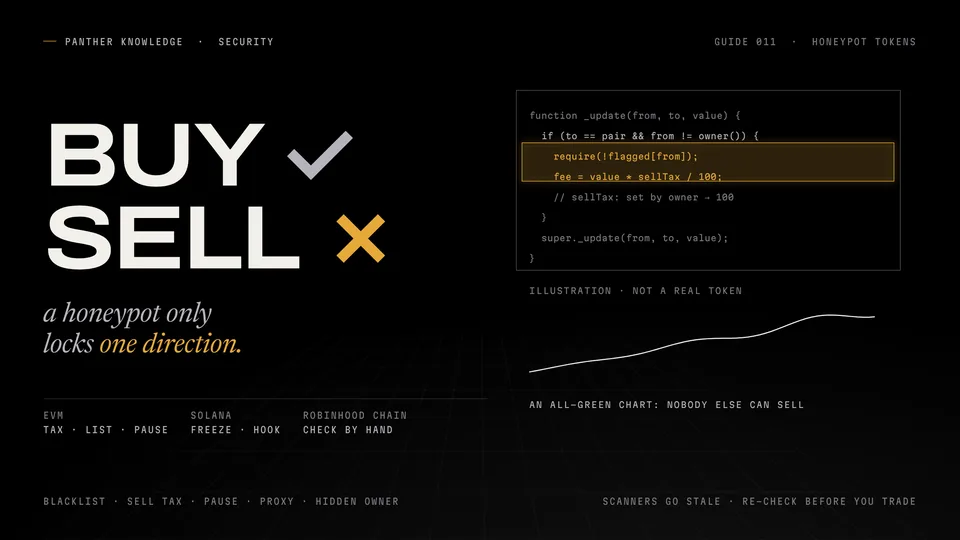
The token can stop you selling. Taxes that the owner can raise, pausable transfers, blacklists: a honeypot needs no liquidity withdrawal at all.
Insiders can sell instead of withdraw. CertiK calls this a soft rug: founders “simply dump only their tokens whilst maintaining a front to their community.” With burned liquidity, the pool is still the exit, for them first.
Liquidity can be thin anyway. A permanently burned $20,000 pool is permanently $20,000. Market cap vs. liquidity vs. FDV works through what that means when you sell.
Tools only recognise what they know. GoPlus states it only marks liquidity as locked for “the token lock addresses or black hole addresses that we have included.” A scanner showing “not locked” may mean an unknown locker, and “locked” may mean a locker it trusts with a lock that ends tomorrow. GoPlus lists supported lockers by chain; for Robinhood Chain (chain ID 4663) that list currently includes its own SafeToken Locker and PinkLock.
How common is this?
Chainalysis defined the classic rug in its 2021 report: developers “drain the funds from the liquidity pool, sending the token’s value to zero, and disappear.” Rug pulls took more than $2.8 billion that year, nearly 90% of it from one centralized exchange’s collapse rather than DEX tokens. Chainalysis’s later study of 2023, as reported by Decrypt, found 54% of Ethereum tokens launched on DEXs that year showed patterns consistent with pump-and-dump schemes, where one address removed more than 70% of liquidity, although those tokens made up only 1.3% of DEX volume. A 2025 Solidus Labs report, as reported by Bitcoin.com, found 93% of the 388,000 Raydium pools it examined showed soft-rug patterns, with a median loss per incident of about $2,800.
Most new tokens fail. Locked or burned liquidity is the minimum, not a quality signal.
Due-diligence checklist
| Check | Pass looks like |
|---|---|
| All pools for the token found | One main pool, or every pool checked |
| LP holders account for ~100% of supply | Dead address and/or a known locker; little or none with the deployer |
| For v3/v4/CLMM: position NFT owner | Dead address or a locker, not a wallet |
| Lock unlock date and owner | Months to years away; owner known; amount matches the claim |
| Mint authority / mint function | Revoked (Solana) or absent (EVM) |
| Freeze authority, pause, blacklist, owner-set taxes | Absent or renounced, verified in the contract |
| Proxy / upgradeable | No, or upgrade controlled by a timelock you can see |
| Holder concentration | No single wallet able to clear the pool |
| Pool depth vs your position | Your exit is a small fraction of the quote side |
Sources
- 01Pools (liquidity tokens) · Uniswap Docsdocs.uniswap.org/contracts/v2/concepts/core-concepts/pools
- 02Smart contracts (minimum liquidity) · Uniswap Docsdocs.uniswap.org/contracts/v2/concepts/protocol-overview/smart-contracts
- 03Introducing Uniswap v3 (positions as NFTs) · Uniswap Labsblog.uniswap.org/uniswap-v3
- 04NonfungiblePositionManager · Uniswap Docsdocs.uniswap.org/contracts/v3/reference/periphery/NonfungiblePositionManager
- 05v4 Position Manager · Uniswap Docsdocs.uniswap.org/contracts/v4/guides/position-manager
- 06PancakeSwap pools (v2 LP tokens, v3 NFTs) · PancakeSwap Docsdocs.pancakeswap.finance/earn/pancakeswap-pools.md
- 07Creating a standard AMM pool · Raydium Docsdocs.raydium.io/raydium/pool-creation/creating-a-standard-amm-pool
- 08Burn & Earn · Raydium Docsdocs.raydium.io/raydium/pool-creation/burn-and-earn
- 09Providing concentrated liquidity (CLMM) · Raydium Docsdocs.raydium.io/raydium/liquidity-providers/providing-concentrated-liquidity-clmm
- 10Glossary: zero address · ethereum.orgethereum.org/en/glossary/
- 11ERC-20 (_burn, transfers to the zero address) · OpenZeppelin Docsdocs.openzeppelin.com/contracts/5.x/api/token/erc20
- 12Token program (burn, mint and freeze authority) · Solana Program Librarywww.solana-program.com/docs/token
- 13Liquidity lockers (and how to check a lock) · UNCX Docsdocs.uncx.network/guides/for-investors/liquidity-lockers
- 14Managing your lock (relock, increment, transfer, split) · UNCX Docsdocs.uncx.network/guides/for-projects/liquidity-lockers-v2/managing-your-lock-withdrawal.md
- 15Liquidity locks · Team Financewww.team.finance/liquidity-locks
- 16How to unlock (and renounce) a PinkLock · PinkSale Docsdocs.pinksale.finance/pinklock/how-to-unlock.md
- 17Transfer lock ownership · PinkSale Docsdocs.pinksale.finance/pinklock/transfer-lock-ownership.md
- 18Token security API response details · GoPlus Docsdocs.gopluslabs.io/reference/response-details
- 19Supported lockers · GoPlus Docsdocs.gopluslabs.io/reference/supported-locker
- 20Staying safe (RugCheck, freeze authority) · Meteora Docsdocs.meteora.ag/user-guide/usage/staying-safe
- 21Soft rug pull vs hard rug pull · CertiKwww.certik.com/blog/what-is-a-soft-rugpull-vs-a-hard-rugpull
- 22Covert rug pulls via contract storage manipulation · SlowMistslowmist.medium.com/beware-of-covert-rug-pulls-exit-scams-driven-by-contract-storage-manipulation-3631c8cbe1a
- 232021 crypto scam revenues (rug pulls) · Chainalysiswww.chainalysis.com/blog/2021-crypto-scam-revenues/
- 2454% of tokens appear to be pump and dumps (Chainalysis study) · Decryptdecrypt.co/215205/54-of-tokens-appear-to-be-pump-and-dumps-but-theres-good-news
- 25Solidus Labs report on Pump.fun and Raydium · Bitcoin.com Newsnews.bitcoin.com/report-exposes-98-6-of-solana-meme-coins-on-pump-fun-as-fraudulent/
Responses
No responses yet. Start the conversation.
Panther Journal — The intelligence brief
Stay ahead of the story.
Free. New investigations delivered when published. Unsubscribe anytime.