Key points
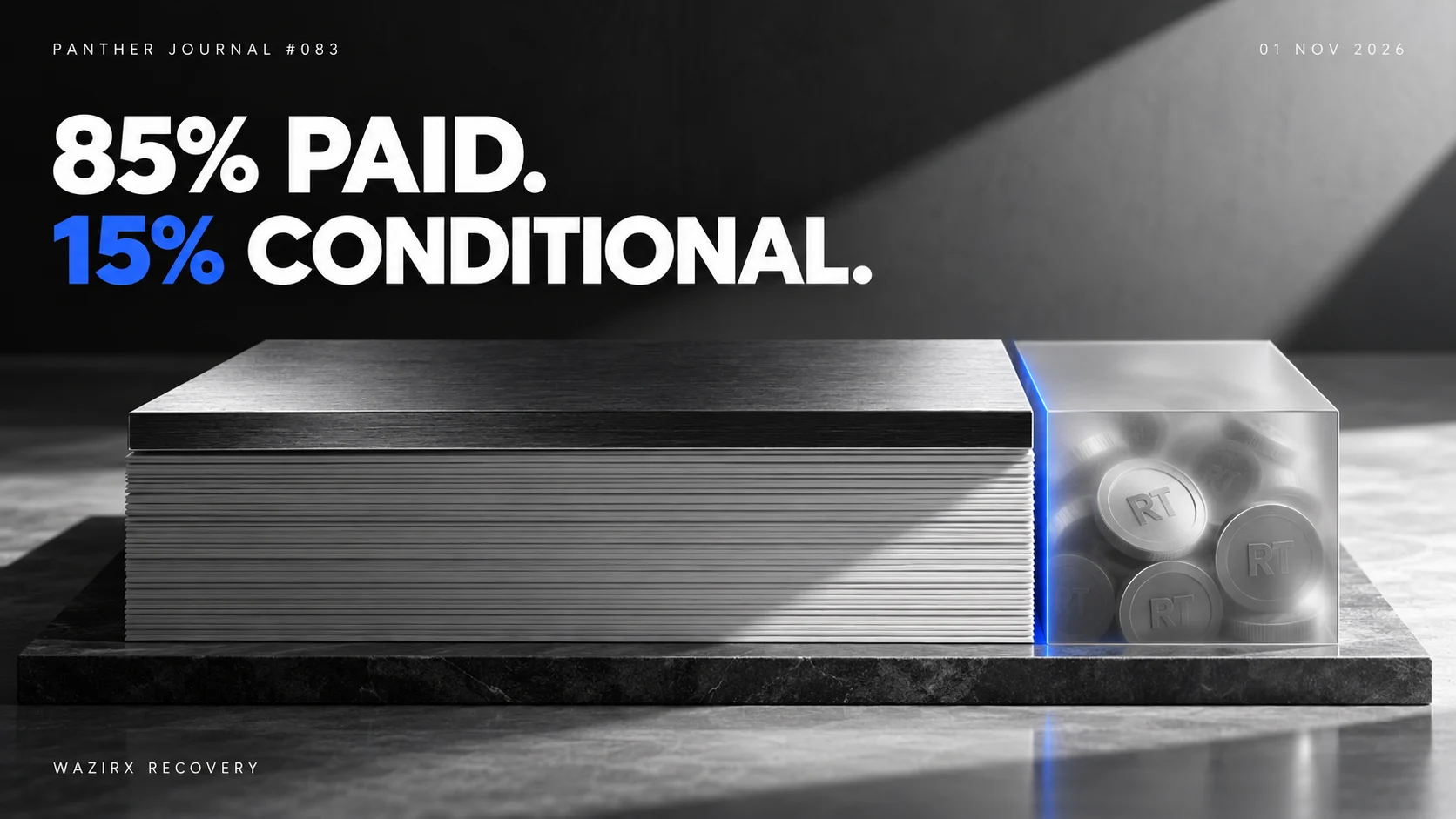
- WazirX says its first distribution represented about 85% of Approved Claims at reference-date pricing, rather than original token quantities.
- Recovery Tokens are conditional creditor claims, separate from the $WRX exchange token.
- The buyback process requires at least $10 million in eligible unencumbered value and further scheme conditions.
- WazirX’s September 7 update reported roughly 34% of INR balances frozen, without a fixed release date for all affected users.
PANTHER JOURNAL #083 — ACCOUNTABILITY
WazirX Recovery Tokens sit beside balances that users can trade, but they do not behave like cash, crypto, or a quoted security. They are a conditional claim on whatever the restructuring produces next.
That distinction is the missing line in the comeback story.
WazirX says it returned approximately 85% of eligible creditors’ Approved Claims after restarting on October 24, 2025. That is a real distribution. It is also a percentage anchored to the scheme’s reference-date valuation—not a promise that every user recovered 85% of the original token quantity or of what that portfolio might be worth today.
The remaining recovery depends on profits, recovered assets, legal conditions and a $10 million milestone. The latest buyback status independently verified for this article is dated mid-October 2026; it is not a complete audit of every creditor account.
What did WazirX actually return?
The July 18, 2024 cyberattack removed more than $230 million from a multisignature wallet and, by WazirX’s own account, broke its ability to maintain 1:1 asset collateral. Trading and withdrawals stopped while Zettai Pte. Ltd., the Singapore entity behind the crypto platform, pursued a court-supervised restructuring.
The Singapore High Court sanctioned the amended scheme on October 13, 2025. WazirX restarted eleven days later and says eligible users received a First Distribution within ten business days.
The phrase “85% returned” needs its full denominator. WazirX describes the payment as approximately 85% of each Approved Claim, valued at the scheme’s reference token pricing date. Its own explanation of rebalancing says the process retained value rather than original token quantity: a user’s token quantity could decrease, while the remaining portfolio was rebuilt across available assets.
That means two users can both be “85% recovered” under the scheme while experiencing very different economic outcomes as token prices move. Mint illustrated the effect with Bitcoin: the rebalanced quantity could be materially smaller than the pre-hack holding even when the accessible rupee value looked similar at reopening.
The percentage is legally and mathematically meaningful. It is not the same thing as restoring the wallet each customer had before the hack.
How WazirX Recovery Tokens buybacks work
Eligible creditors also received Recovery Tokens, or RTs, in January 2026. These are not WazirX’s exchange utility token, $WRX. Holding WRX does not create a repayment right under the restructuring; RTs represent scheme creditors’ proportional entitlement to potential future recoveries.
WazirX says RTs are not currently tradable. A future market is possible only if legal and regulatory requirements are satisfied, and no listing is guaranteed.
The buyback mechanism has another gate. At the end of recurring three-month periods, at least $10 million in unencumbered value must be realized from eligible sources before a Recovery Token Purchase Milestone is reached. Amounts below that threshold roll forward. Even after a milestone, the company determines the appropriate sum available for purchases, and the token issuer must receive that Milestone Amount before making offers.
This is a recovery instrument with conditions, not a dated IOU for the missing balance.
Growth figures leave creditors with another question
WazirX’s October 24 anniversary update says active traders more than doubled from July to September, spot volume rose 124% from June to September, and futures volume grew sharply. Those are company-reported activity figures. The update did not publish a Recovery Token buyback, a milestone amount, or a current net shared-surplus figure. Company growth metrics alone do not show what cash is available to purchase creditor claims.
Independent reporting by The Crypto Times found no public buyback announcement as of mid-October. On September 7, WazirX itself said there was no specific buyback date or amount yet.
Frozen INR is a separate unresolved problem
Crypto scheme creditors are not the only affected group.
In its September 7 AMA summary, WazirX said approximately 34% of INR balances remained frozen in its bank account while legal proceedings continued. It said a first tranche had been released to some users with smaller balances, but gave no fixed date for everyone else.
That statement prevents two misleading conclusions. It is wrong to say WazirX returned nothing: the First Distribution occurred, and some INR users received phased releases. It is equally wrong to treat the restart as a complete refund: RT value remains conditional, and a stated cohort of INR users was still waiting.
Court approval did not settle responsibility for the hack
WazirX says the attacked wallet used Liminal’s custody infrastructure and required three WazirX signers followed by Liminal’s approval. Liminal says its platform and infrastructure were not breached and described the event as a customer-level compromise. The competing accounts mean the disputed technical cause should not be presented as settled.
A court-approved restructuring establishes a recovery process. It does not, by itself, establish the disputed technical cause of the theft or prove fraud by the exchange. The sources reviewed here do not justify presenting an insider scam as a settled finding.
What creditors should demand next
The next credible accountability update should make four numbers easy to find:
- Cumulative unencumbered value counted toward the $10 million milestone.
- Net shared surplus after the scheme’s operating and capital reserves.
- The amount, price and timing of any first RT purchase offer.
- The remaining frozen-INR amount, affected cohorts and legal status.
Trading volume, product launches and deposit growth can help rebuild the business. They are not substitutes for a creditor ledger.
The Panther takeaway
WazirX has paid a first distribution. It has not finished the recovery.
The honest test is no longer whether the exchange is active. It is whether activity produces a transparent, auditable path from fees and recovered assets to cash that creditors can actually withdraw.
Sources and verification
- WazirX: cyberattack incident and collateral impact, July 21, 2024.
- WazirX: Recovery Token allocation and conditions, January 9, 2026, updated February 4.
- WazirX: Recovery Token purchase mechanics, including the $10 million milestone and pricing formula.
- WazirX AMA summary, September 7, 2026, covering frozen INR and RT timing.
- WazirX restart anniversary, October 24, 2026.
- Mint: WazirX reopening and creditor outcomes, October 24, 2025.
- The Crypto Times: RT buyback status and company response, October 23, 2026.
- Liminal’s response to the wallet compromise, July 29, 2024.
Responses
No responses yet. Start the conversation.
Panther Journal — The intelligence brief
Stay ahead of the story.
Free. New investigations delivered when published. Unsubscribe anytime.