Key points
- TLD Markets received DCM designation on November 16; Backpack Clearing’s DCO registration is dated November 13.
- Backpack plans 24/7 leveraged crypto perps with unified global liquidity. Its U.S. page remains a waitlist.
- Check actual U.S. eligibility and contract rules when trading opens; approval does not remove market risk.
PANTHER JOURNAL #132
The U.S. approval is on the record. The trading screen is still a waitlist. Backpack’s push to bring a globally connected crypto derivatives market into the United States has cleared a consequential regulatory threshold, with the customer launch still ahead.
The Backpack CFTC approval announced on November 16 covers two distinct functions: an exchange and a clearinghouse. For crypto traders, the important questions are which entities received permission, what the company plans to offer and when customers can actually use it.
Two orders, two different jobs
The CFTC’s November 16 order of designation approves TLD Markets, Inc. as a designated contract market, or DCM. It records plans for an anonymous electronic central limit order book and requires listed contracts to clear through a CFTC-registered derivatives clearing organization.
The order also sets out the exchange’s continuing responsibilities: surveillance, reporting, recordkeeping, enforcement and compliance with the Commodity Exchange Act and Commission rules. Approval depends on the representations in the application; material changes can require a new or amended order.
Separately, the November 13 registration order approves TLD Clearing, Inc., doing business as Backpack Clearing, as a DCO. Its permitted scope includes margined futures and fully collateralized futures, options on futures and swaps. The CFTC’s current filing record lists the organization as registered.
Those dates matter. A clearing registration alone would leave the separate exchange application unresolved. The later DCM order establishes that both regulatory steps have occurred.
What Backpack says the structure will deliver
In its November 16 announcement, Backpack describes a U.S. offering built around leveraged crypto perpetual futures, round-the-clock trading, fiat or crypto collateral, cross-margin and access to global liquidity through one unified order book.
These are the company’s stated product plans. The orders establish the entities’ regulatory footing; readers should still look for the actual U.S. contract specifications and customer terms before treating every announced feature as available to them.
The Block’s independent report, updated November 17, corroborates Backpack’s approvals and places them alongside tZERO’s separate derivatives infrastructure approvals. The significance extends beyond one platform’s marketing: blockchain-based execution and settlement are being admitted into the established U.S. derivatives framework.
Permission has arrived; access remains a separate check
When checked on November 18, Backpack’s official U.S. page displayed a waitlist and said it would notify visitors when trading opens. The announcement provides no U.S. opening date.
For prospective users, the next useful evidence is an operational launch notice, the eligible customer cohort, listed contracts and their collateral, funding, liquidation and withdrawal rules. An existing global Backpack account or a waitlist entry should not be treated as proof of U.S. trading access.
Funding deserves particular attention once specifications appear. Panther’s guide to perpetual-futures funding explains why the recurring cost can matter alongside the entry price. Rates and mechanics from another venue should never be assumed to apply to a new contract.
Blockchain architecture still carries market obligations
CFTC Chairman Michael Selig’s November 16 statement emphasizes that firms using novel infrastructure must meet the same regulatory standards as traditional operators. He names anti-money-laundering programs, customer protection, segregation, surveillance, financial resources, risk management and system safeguards.
That is the practical policy development: a route for different technology under existing obligations. It does not remove trading risk. Backpack’s own site warns that perpetual futures can lead to liquidation and loss of the entire collateral.
Token holders should keep the categories separate as well. Backpack identifies $BP as its native token on its official brand page. The reviewed orders approve named market entities; they provide no token valuation or return promise.
Panther Takeaway
Backpack has secured the exchange and clearing approvals needed for its U.S. derivatives push. The next milestone is usable access with published contract rules. Judge the launch by those rules and the service that opens, rather than extrapolating from an approval headline.
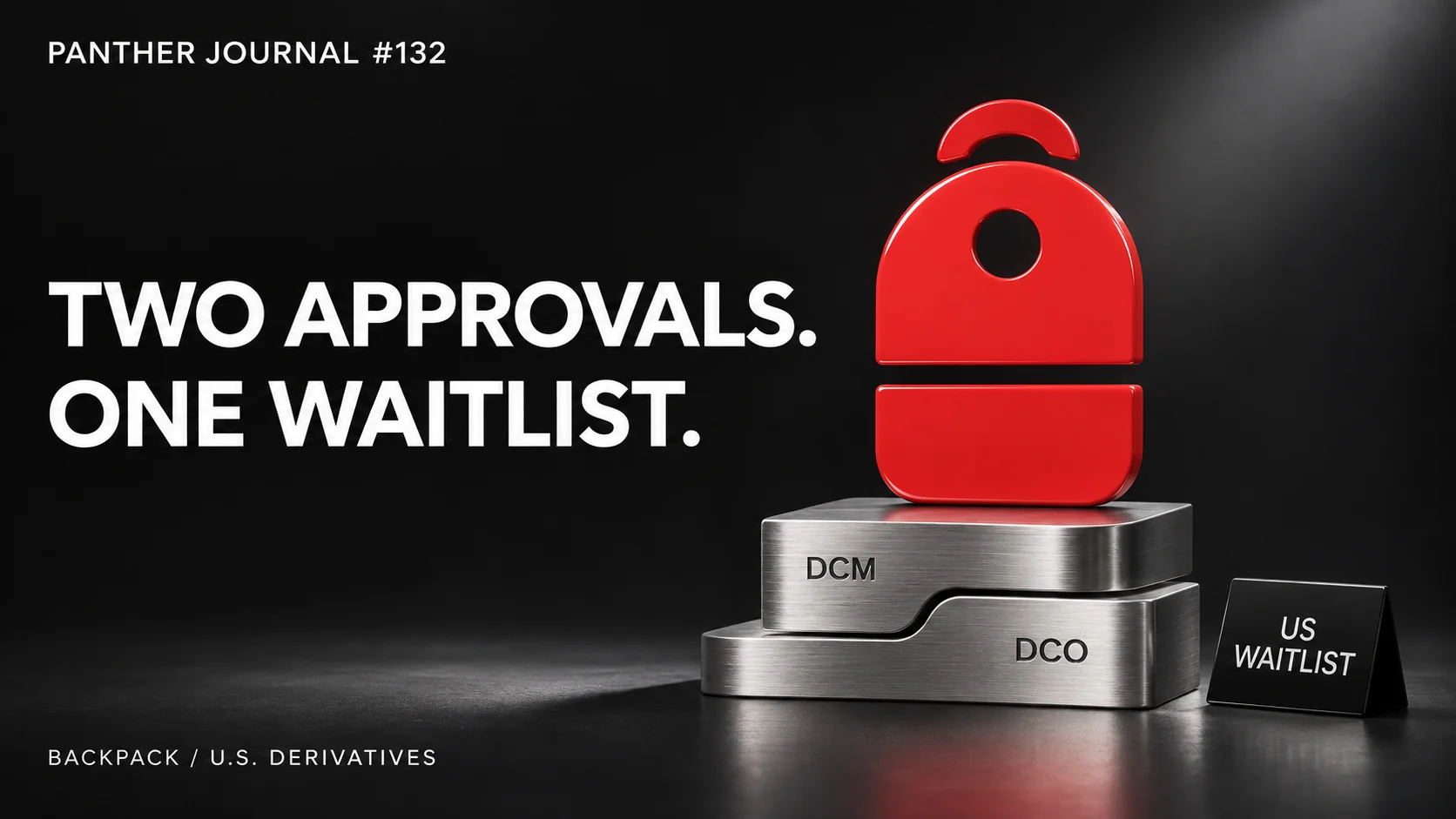
Verification checked November 18, 2026: original CFTC orders and registry, Backpack’s announcement and live U.S. waitlist, and independent reporting. Cover: conceptual illustration by Panther, created with ChatGPT; Backpack Red references its official brand guidelines.
Responses
No responses yet. Start the conversation.
Panther Journal — The intelligence brief
Stay ahead of the story.
Free. New investigations delivered when published. Unsubscribe anytime.