Key points
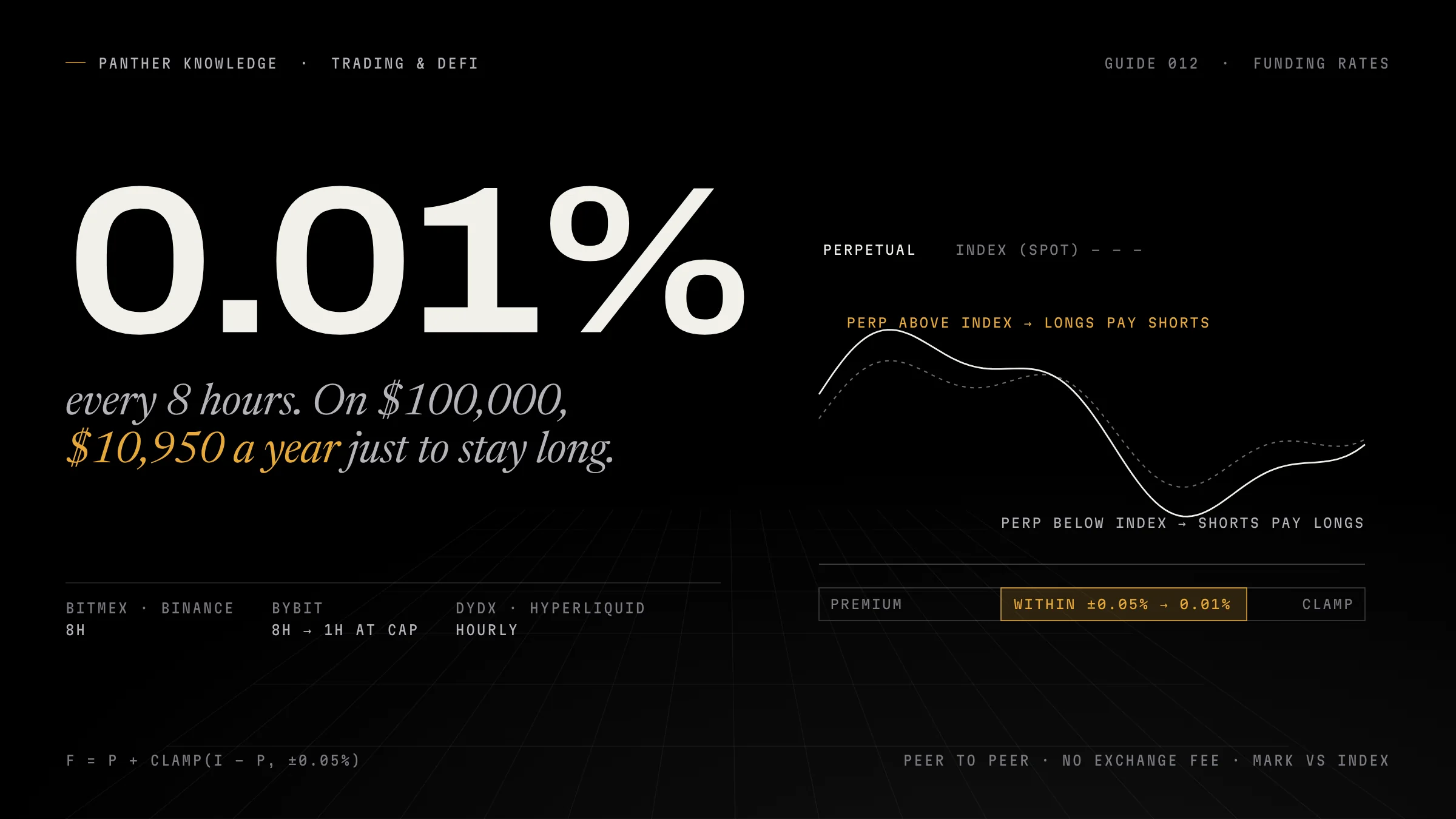
- Funding keeps a perpetual near the index price: when it trades above, longs pay shorts; below, shorts pay longs.
- It is peer to peer. BitMEX, Binance and Hyperliquid all state they take no cut of funding payments.
- Funding = Premium + clamp(Interest − Premium, ±0.05%). Whenever the premium is within 0.05% of the 0.01% interest rate, funding is exactly 0.01%.
- At the 0.01% baseline, a $100,000 long pays about $10,950 a year; at 5x leverage that is about 55% of the margin posted.
- Funding is paid from margin, so it moves your liquidation price even when the market does not.
- Funding arbitrage carries liquidation, flip, execution and venue risk. It is a trade, not a yield.
A perpetual future is a futures contract that never expires. That one design choice creates a problem: an ordinary future converges to the spot price on its expiry date, so what stops a perpetual from drifting away from the asset it tracks forever? The answer is the funding rate, a small payment between traders on opposite sides, settled every few hours, that makes it expensive to sit on the crowded side.
Funding looks like a footnote on the trading screen. Over a year it can be larger than the move you were trading. This guide explains exactly how it is calculated on BitMEX, Binance, Bybit, dYdX and Hyperliquid, why it sits at 0.01% most of the time, what positive and negative funding cost in dollars, and why “collecting funding” is not the risk-free yield it is often sold as.
Three prices on every perpetual
| Price | What it is | Used for |
|---|---|---|
| Last price | The last trade on this exchange’s perpetual | Your fills and the chart |
| Index price | A weighted average of the asset’s spot price across several exchanges | The reference the perpetual is anchored to |
| Mark price | A smoothed estimate built from the index and the perpetual’s own book | Unrealised profit and loss, and liquidations |
Binance computes its mark price as the median of three numbers: a price derived from the index and the last funding rate, the index plus a 30-second moving average of the basis, and the contract’s own price. It says it uses the mark price “to prevent unnecessary liquidations and discourage market manipulations.” Hyperliquid builds its mark price from its oracle, its own order book and other exchanges’ perpetual prices, and uses it for “margining, liquidations, triggering TP/SL, and computing unrealized pnl.”
Funding exists to keep the perpetual’s price close to the index.
Who pays whom
When the perpetual trades above the index, the longs are paying up to be long. Funding is positive, and longs pay shorts. When it trades below the index, funding is negative and shorts pay longs. BitMEX: “Long position holders pay short position holders” when funding is positive, and the reverse when it is negative.
Two facts that surprise people:
- The exchange does not keep it. BitMEX “does not take any cut, commission, or portion of the funding fee.” Binance “does not charge fees on Funding Payments.” Hyperliquid: “Funding is purely peer-to-peer and no fees are collected on the payments.” Every dollar a long pays, a short receives.
- You only pay if you hold a position at the funding time. Funding is a snapshot of open positions at each settlement, not a charge on trading.
The payment itself is simple. Binance: Funding Amount = Nominal Value of Positions × Funding Rate. BitMEX: Funding Payment = Funding Rate × Position Value.
The formula, and why it sits at 0.01%
BitMEX, Binance, Bybit and Hyperliquid all use the same shape:
Funding Rate = Premium Index + clamp(Interest Rate − Premium Index, −0.05%, +0.05%)- Premium Index measures how far the perpetual trades from the index. Binance and Bybit compute it from the price at which a standard-size order would fill on each side of the book (the impact bid and impact ask) compared with the index, sampled through the funding period and averaged.
- Interest Rate is fixed at 0.01% per 8 hours on most contracts (0.03% a day on Binance and Bybit; Hyperliquid sets 0.01% per 8 hours, which is 0.00125% an hour).
- clamp(x, −0.05%, +0.05%) limits that correction term to ±0.05%.
The clamp hides a useful property. Whenever the premium is within 0.05% of the interest rate, the two premium terms cancel and the funding rate is exactly the interest rate:
| Premium index | Funding rate |
|---|---|
| 0.000% | 0.0100% |
| +0.030% | 0.0100% |
| −0.040% | 0.0100% |
| +0.120% | +0.0700% |
| −0.200% | −0.1500% |
That is why funding on a calm market prints 0.0100% period after period. It only moves when the perpetual trades meaningfully away from spot, and then it moves with the premium.
Caps and intervals differ by venue
| Venue | Settlement | Interest rate | Cap |
|---|---|---|---|
| BitMEX | Every 8 hours (04:00, 12:00, 20:00 UTC) | 0.01% per 8h | See each contract’s specification |
| Binance USDⓈ-M | Every 8 hours by default (00:00, 08:00, 16:00 UTC); some contracts every 4h; switches to every 1h when funding hits its cap or floor | 0.03% per day (0.01% per 8h) by default | ±2% for most contracts; listed contracts use ±0.75 × maintenance margin ratio |
| Bybit | Every 8 hours on most contracts; switches to hourly at the limit | 0.03% per day; 0% on some pairs | Tied to the initial and maintenance margin rates |
| dYdX v4 | Every hour | 0% on cross markets; 0.125 bps per hour on isolated markets | 600% × (initial − maintenance margin) per 8 hours |
| Hyperliquid | Every hour, at one-eighth of the computed 8-hour rate | 0.01% per 8h | 4% per hour |
On dYdX, validators submit premium votes from their view of the order book, the median vote becomes each minute’s sample, and the hourly premium is the average of 60 samples. On Hyperliquid it is sampled every 5 seconds against an oracle built from centralized-exchange prices, and the payment uses the oracle price, not the mark price: position_size × oracle_price × funding_rate.
GMX v2 uses a different design: positions pay a funding fee that depends on the imbalance between long and short open interest, plus a separate borrowing fee that depends on pool utilisation. The numbers are not comparable one to one with order-book perpetuals.
What funding costs in dollars
On a $100,000 position settled every 8 hours:
| Funding rate (per 8h) | Each payment | Per day | Per year, if it never changed |
|---|---|---|---|
| +0.01% (the baseline) | Long pays $10 | $30 | $10,950 (10.95%) |
| +0.03% (busy market) | Long pays $30 | $90 | $32,850 (32.85%) |
| −0.05% (crowded shorts) | Short pays $50 | $150 | $54,750 (54.75%) |
The baseline alone is close to 11% a year for a long holding a leveraged position. At 5× leverage the same payment is charged on the full $100,000 notional, but you only posted $20,000 of margin, so it costs about 55% a year of your margin at the baseline rate. Leverage multiplies funding exactly as it multiplies price moves.
On an hourly venue the payment is smaller and more frequent: at the baseline, Hyperliquid charges 0.00125% an hour, $1.25 an hour on $100,000.
Funding and liquidation are connected
Funding is paid from, or added to, your margin. dYdX: “Realized P&L increases or decreases while you hold a position due to funding fees.” Hyperliquid notes that the liquidation price it displays can shift “due to funding payments.”
How liquidation works, using exchange definitions:
- Initial margin is what you post to open the position. Binance: “the Initial Margin is determined by the leverage you select.” Hyperliquid:
position_size × mark_price / leverage. - Maintenance margin is the minimum collateral to keep it open. Binance: notional value × maintenance margin rate − a maintenance amount, with rates rising as position size grows. Hyperliquid sets it at half of the initial margin at maximum leverage, between 1.25% and 16.7% depending on the asset.
- Liquidation happens when your collateral, including unrealised profit or loss, falls below maintenance margin, measured at the mark price. On Binance, part of the remaining collateral is paid as a liquidation fee.
A position that is paying funding every 8 hours is slowly losing margin even when the price does not move. On a highly leveraged position held for weeks, that alone can be what pushes it over the line.
“Free yield” from funding is not free
The classic funding trade, crypto’s version of the cash-and-carry trade, is to buy the asset spot and short the same amount of perpetual. Price moves cancel out, and when funding is positive the short collects it. At a steady +0.03% per 8 hours, that is $90 a day on $100,000 of each leg.
BitMEX’s own guide to the trade lists the catches:
- Funding flips. “If BitMEX’s funding rates cool or turns negative, staying long means you pay.” The rate is not fixed; you are betting it stays positive.
- Each leg can be liquidated. “Even while hedging, each leg carries its own liquidation price.” A sharp rally can liquidate the short perpetual before you rebalance, leaving you unhedged.
- Execution. “Wide markets during volatility can blow the hedge open.” You have to enter and exit both legs together.
- Friction. “Make sure the funding you earn is more than the friction you pay”: trading fees on two legs, spreads, transfers between venues.
- Unpredictability. “The exact profit isn’t possible to predict as funding rates swing with the market.”
Add the risks no formula captures: the exchange or protocol holding your collateral, and the stablecoin your margin is denominated in.
What funding tells you about the market
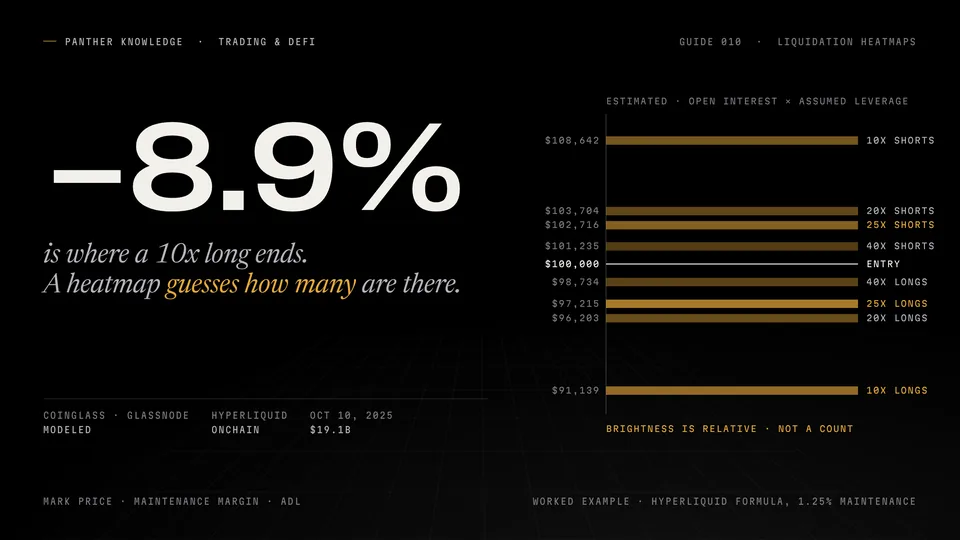
Persistently high positive funding means longs are crowded and paying to stay in. It does not tell you the price will fall, only that the positioning is one-sided and that a drop could force many longs out at once. Deeply negative funding is the mirror image. Funding is a positioning gauge, best read alongside open interest and the liquidation levels it implies, not a signal on its own.
Checklist before you hold a perpetual
| Question | Where to look |
|---|---|
| What is the current funding rate, and the predicted next one? | The contract’s funding panel |
| How often does this venue settle? | 8h, 4h or 1h; check the contract specification |
| What does funding cost me per day at my notional? | Notional × rate × settlements per day |
| What is my liquidation price, measured on mark price? | The position panel; it moves as funding is paid |
| If I am collecting funding, what happens if it flips or I get liquidated on one leg? | Margin buffers on both legs; an exit plan |
Sources
- 01What is a perpetual contract? · BitMEXsupport.bitmex.com/hc/en-gb/articles/18588780769437-What-Is-a-Perpetual-Contract
- 02Why is the funding rate higher or lower than I expect? · BitMEXsupport.bitmex.com/hc/en-gb/articles/24430352016157-Why-is-the-Funding-Rate-for-a-contract-higher-or-lower-than-I-expect
- 03Does BitMEX take a cut of the funding fee? · BitMEXsupport.bitmex.com/hc/en-gb/articles/7160020400669-Does-BitMEX-Take-a-Cut-of-the-Funding-Fee
- 04Introduction to Binance Futures funding rates · Binancewww.binance.com/en/support/faq/detail/360033525031
- 05Mark price and index price · Binancewww.binance.com/en/support/faq/detail/360033525071
- 06Leverage and margin of USDⓈ-M futures · Binancewww.binance.com/en/support/faq/360033162192
- 07Liquidation · Binancewww.binance.com/en/support/faq/detail/360033525271
- 08Introduction to funding rate · Bybitwww.bybit.com/en/help-center/article/Introduction-to-Funding-Rate
- 09Funding · dYdX Docsdocs.dydx.xyz/concepts/trading/funding
- 10Funding · Hyperliquid Docshyperliquid.gitbook.io/hyperliquid-docs/trading/funding
- 11Robust price indices (oracle and mark price) · Hyperliquid Docshyperliquid.gitbook.io/hyperliquid-docs/trading/robust-price-indices
- 12Margining · Hyperliquid Docshyperliquid.gitbook.io/hyperliquid-docs/trading/margining
- 13Liquidations · Hyperliquid Docshyperliquid.gitbook.io/hyperliquid-docs/trading/liquidations
- 14Trading on GMX V2 (funding and borrowing fees) · GMX Docsdocs.gmx.io/docs/trading/v2
- 15Harvest funding payments (funding arbitrage risks) · BitMEX Blogwww.bitmex.com/blog/harvest-funding-payments-on-hyperliquid
Responses
No responses yet. Start the conversation.
Panther Journal — The intelligence brief
Stay ahead of the story.
Free. New investigations delivered when published. Unsubscribe anytime.