Key points
- A lookalike address in transaction history is not proof of a trusted recipient—or, by itself, of a stolen key.
- Zero-value token-transfer events can appear without your signature on the underlying transaction; inspect the sender, contract and amount.
- Verify the full destination from an independent source, then compare it again on the signing screen—even after a successful test.
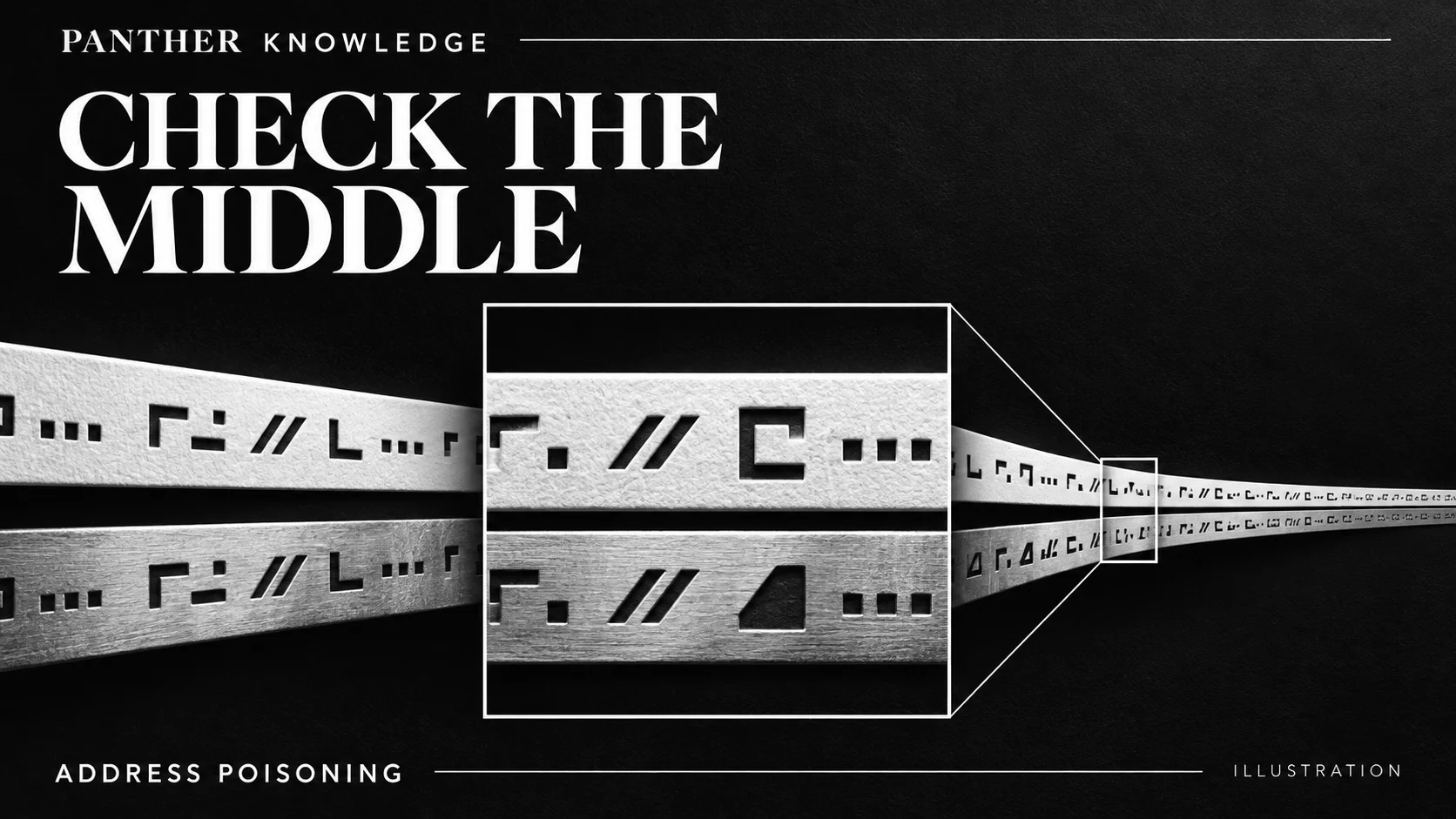
Crypto address poisoning exploits a familiar moment: the first characters look right. The last characters look right. You have sent to this person before. You paste the address from history and reach for Confirm.
The middle is where the payment can go wrong.
Crypto address poisoning plants a lookalike destination in your activity feed, hoping you will reuse it for a real transfer. The initial entry can involve almost no money. The expensive step is the later payment you authorize yourself. This guide explains how to inspect the evidence and build a safer send routine, especially on Ethereum and other EVM networks.
How crypto address poisoning works
An attacker observes public activity and generates an address resembling one you recognize. A small or zero-value token transfer then puts that lookalike near genuine activity. A shortened display can make two different destinations appear familiar.
MetaMask’s safety guide describes this sequence. Simply receiving the planted entry does not establish that your recovery phrase was stolen. The attack is designed to influence your next choice of recipient.
Independent research also documents the mechanism. In Blockchain Address Poisoning, Taro Tsuchiya and coauthors studied Ethereum and BSC activity over two years. Their paper reports 270 million detected on-chain attack attempts and at least $83.8 million in losses across identified incidents. Those are findings for the study’s dataset, not a live November 2026 loss total or a prediction about your wallet.
A transfer row does not prove you signed
A confusing version looks like an outgoing token transfer you never approved. Before concluding that your private key was used, distinguish the transaction sender from the addresses named inside token-transfer events.
The ERC-20 standard requires zero-value transfers to emit a Transfer event. Ledger’s technical explanation shows how some token implementations allow a zero-value transferFrom call involving another user’s address even without a positive allowance. A wallet can then display an event that appears to connect that user with the attacker’s address.
That event alone does not prove the user signed the underlying transaction, gave spending permission, or lost a positive token balance. Inspect the transaction’s actual sender, token contract, amount and logs. Implementation details matter; do not assume every token behaves identically.
A familiar ticker adds another distraction. The contract emitting the event determines which token is involved. Panther’s token contract verification guide explains that separate identity check; the Etherscan guide explains the receipt and transfer tabs.
Worked example: the safe test and the unsafe remainder
Hypothetical training example. No real addresses, victim or transaction are being claimed.
A business plans to send 2,000 units of a token. The recipient supplies an address through an established channel. The sender verifies it and sends a test of 10 units, which the recipient confirms receiving.
Before sending the remaining 1,990 units, the sender opens recent activity. A new lookalike entry sits beside the genuine test. Instead of reusing the verified destination, the sender copies the address from that new row.
The test did its job for the first destination. It says nothing about the different destination selected afterwards.
| Checkpoint | What it establishes | What it leaves unresolved |
|---|---|---|
| Recipient confirms the 10-unit test | That test reached the intended recipient | Whether the next transfer uses the same full address |
| Start and end characters match | Partial visual similarity | Whether the middle characters differ |
| Full destination matches the independently verified source | The intended address was selected for review | Whether the signing screen still shows that destination |
The operational lesson is to preserve the verified destination across the whole payment. A successful small transfer is useful evidence, but it should never become permission to copy a fresh row without checking it.
Get the recipient from the source, then check the signing screen
Trezor’s sending instructions tell users to obtain the address from the payee, their own wallet or the exchange deposit screen. They also require checking the destination on the device against that original source. This catches a different hazard too: malware replacing an address after it is pasted.
For a repeat payment, use this order:
- Open the recipient’s verified payment channel or the service’s current deposit page. Confirm the asset, network and any required memo or tag.
- Compare the complete address. Expand shortened displays and inspect the middle as carefully as the ends.
- Save a verified contact or destination where your wallet supports it. Re-verify a requested change through an established independent channel.
- At signing, compare the actual destination with the verified source again. Also check the amount and network.
- For staged payments, keep that verified destination fixed and confirm receipt before proceeding.
A hardware wallet adds a trusted display checkpoint. It cannot decide that a technically valid address belongs to your intended supplier. If you approve the wrong address on its screen, protecting the private key has not corrected the recipient choice.
Wallet warnings help; absence of a warning is not a verdict
MetaMask’s June 17, 2026 product announcement describes lookalike detection in Mobile and Extension across EVM networks. It compares pasted destinations with prior interactions and also warns about first-time recipients. These are the provider’s described protections, not a Panther test of every app version or attack variant.
Trezor documents filtering that blurs suspected poisoning entries and marks them unverified. Different wallets and explorers may present the same activity differently.
Treat an alert as a reason to stop and establish the recipient. A new-recipient warning does not by itself prove fraud. Conversely, a quiet interface is not independent confirmation of identity. A clean-looking history and a verified payment instruction answer different questions.
If you notice it before—or after—sending
Before sending, discard the history-derived destination and return to the original recipient source. Do not send a “verification” payment to a stranger offering to clean the wallet. An unexplained incoming entry alone does not establish a compromised key; investigate any actual unauthorized outflow separately.
After a mistaken transfer, preserve the network, transaction hash, full destination, token contract, amount and the original payment instruction. Contact the wallet’s official support and any relevant receiving service promptly. MetaMask’s reporting guidance recommends reporting the suspected address to support, the explorer and the appropriate cybercrime authority. A report is not a reversal request that a self-custodial wallet can simply execute. Recovery depends on circumstances and cannot be promised.
Keep private keys, recovery phrases and authentication codes out of reports. Share public transaction evidence only with the people who need it; addresses can expose financial activity.
Sources and verification
Reviewed against the linked wallet-provider documentation, ERC-20 specification and independent research on November 10, 2026. The worked example and table are Panther’s illustrative reasoning, not a live-wallet test. No wallet was connected and no transfer was executed for this guide. Interface protections can change; verify the current app and the complete recipient before signing.
Sources
- 01Address poisoning scams · MetaMasksupport.metamask.io/stay-safe/protect-yourself/wallet-and-hardware/address-poisoning-scams
- 02ERC-20 Token Standard · Ethereum Improvement Proposalseips.ethereum.org/EIPS/eip-20
- 03The Antidote To On-Chain Poisoning · Ledgerwww.ledger.com/blog/address-poisoning
- 04Blockchain Address Poisoning (2025 research) · Tsuchiya et al.arxiv.org/abs/2501.16681
- 05Send crypto in Trezor Suite · Trezortrezor.io/guides/sending-receiving-staking-funds/sending-receiving/send-crypto-in-trezor-suite
Responses
No responses yet. Start the conversation.
Panther Journal — The intelligence brief
Stay ahead of the story.
Free. New investigations delivered when published. Unsubscribe anytime.