Key points
- A token name, ticker and logo are metadata. On EVM chains, the contract address plus the chain identifies the asset; on Solana, use the mint address.
- Get the address from the issuer or project’s official documentation, then confirm the same full address on the correct blockchain explorer.
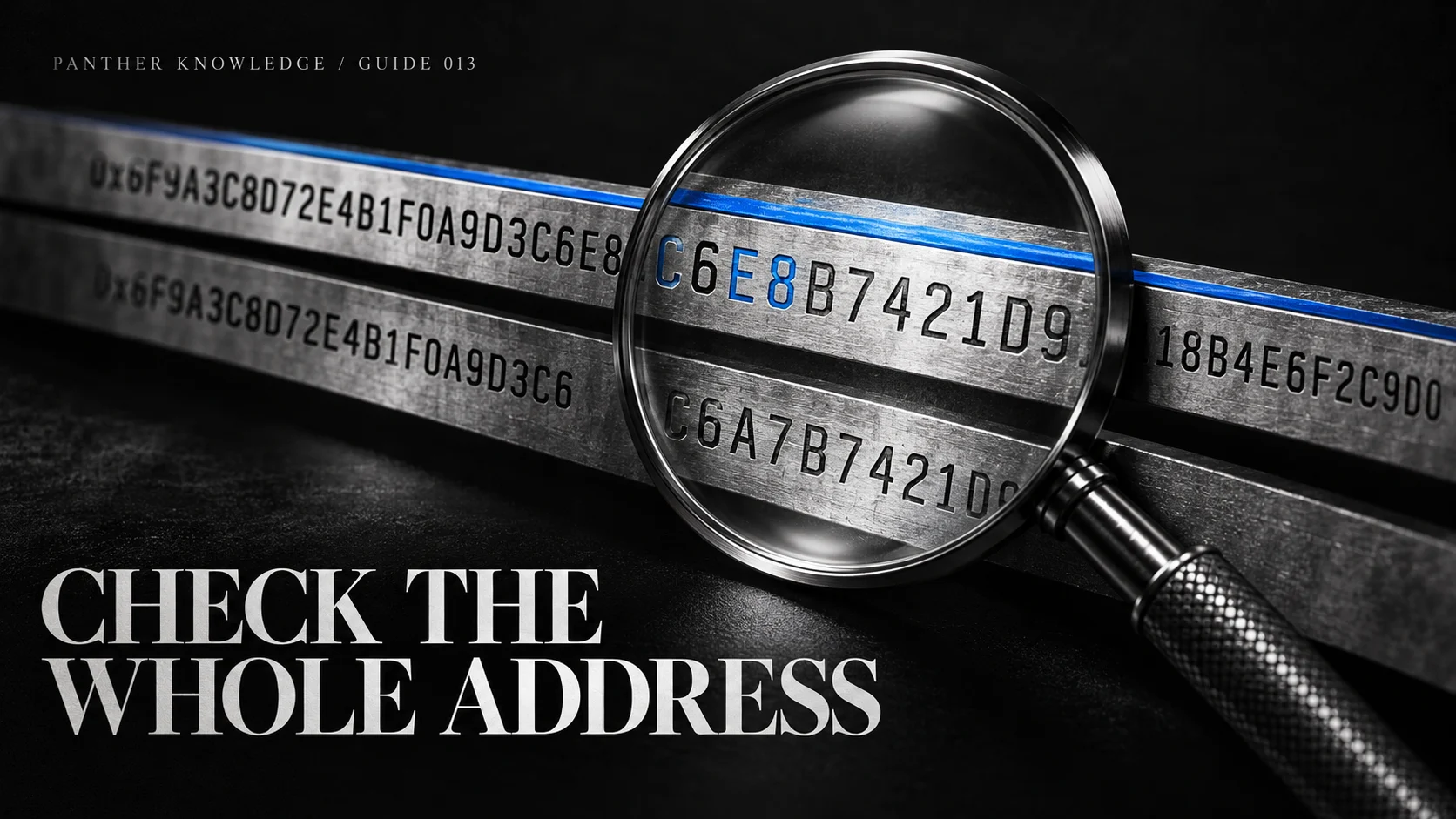
- Compare every character. Wallets and explorers often shorten addresses, and lookalikes can share a convincing beginning and ending.
- A matching address proves which contract you selected. It does not prove the token is safe, liquid, transferable or free of privileged controls.
To verify a token contract address, ignore the familiar logo for a moment. The token in the swap window says USDC. The logo is familiar. The balance looks right. None of those details proves that you selected USD Coin.
On permissionless chains, anyone can deploy a token that reuses another token’s name, symbol and artwork. Ethereum.org’s guide to scam tokens states the problem plainly: ERC-20 contracts can share the same name and symbol. The detail they cannot share on the same network is the contract address.
That makes token verification a two-part question:
- Which blockchain are you using?
- What is the token’s complete contract or mint address on that blockchain?
Do both checks before the wallet asks for a signature. A token search result, verification badge or portfolio balance can help you navigate. It should not be the final authority.
What is a token contract address?
A token contract address identifies the program that defines an EVM token’s balances, transfers and permissions. Uniswap describes it as the unique blockchain address representing the token contract.
The same-looking asset can have different addresses on different chains. Circle’s current USDC registry lists these three native deployments:
| Network | Circle-listed native USDC address |
|---|---|
| Ethereum | 0xA0b86991c6218b36c1d19D4a2e9Eb0cE3606eB48 |
| Base | 0x833589fCD6eDb6E08f4c7C32D4f71b54bdA02913 |
| Arbitrum | 0xaf88d065e77c8cC2239327C5EDb3A432268e5831 |
All three are native USDC. They are still different contracts on different networks.
Solana uses the term mint address. Phantom’s documentation says the mint address plays the same identity role: compare it with the address published by the project’s official source. Other ecosystems use different formats, but the principle is unchanged. Asset identity is chain-specific.
Why the ticker is not enough
ERC-20 names and symbols are chosen by contract deployers. A malicious token can call itself USDT, ARB or any other recognizable ticker. It can copy a logo in an interface. It can even send tokens to prominent wallets so the holder list looks reassuring.
Ethereum.org demonstrates this with a token designed to resemble Arbitrum’s ARB. The guide notes that token balances and transfer events are controlled by the token contract itself. A scam contract can manufacture activity that looks convincing without becoming the legitimate asset.
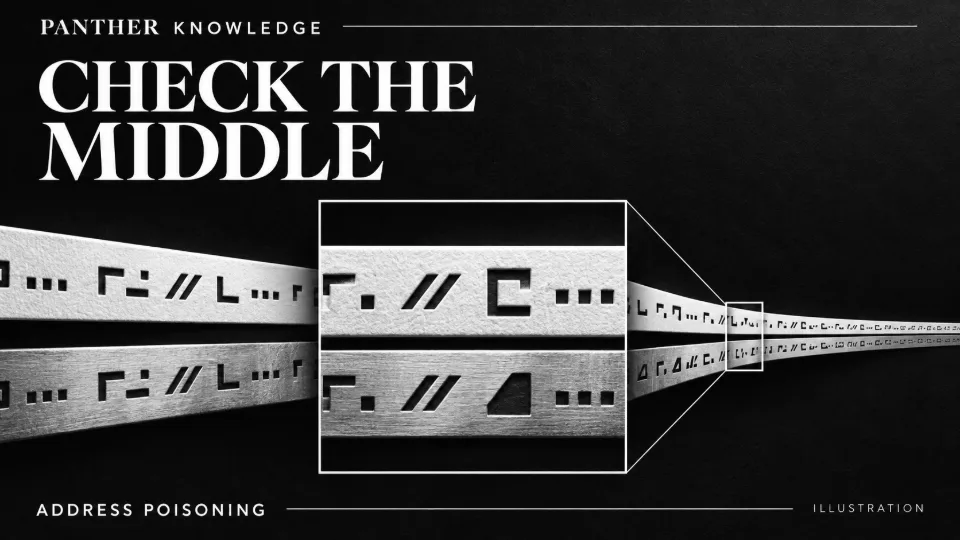
The FBI has also warned about impersonation tokens used alongside address-poisoning attacks. In that pattern, criminals create lookalike tokens or addresses and rely on wallets shortening long hexadecimal strings. The first and last characters may look familiar while the middle is different.
That is why checking 0xA0b8…6eB48 is weaker than checking all 42 characters of the Ethereum USDC address.
How to verify a token contract address: the five-check workflow
1. Lock the network first
Before searching for a token, read the selected network in the wallet or swap app. Ethereum, Base, Arbitrum and BNB Chain all use 0x addresses. A familiar address format does not tell you which chain you are on.
If you intend to withdraw from an exchange, confirm the exchange’s asset-and-network pair as well. “USDC on Arbitrum” and “USDC on Ethereum” are different delivery routes even when the receiving wallet uses the same account address.
2. Start with the issuer or project
Use the issuer’s official documentation, verified project website or official repository to find the contract address for that exact chain. For USDC, Circle maintains a network-by-network contract registry. For a governance token, the protocol’s deployment documentation or governance record may be the primary source.
Avoid taking the address from a search advertisement, reply, unsolicited direct message or copied social post. A polished page can still be an impersonation site. Open known official pages from a saved bookmark or independently verified domain.
3. Open the full address on the correct explorer
Paste the address into the explorer for the network you selected. Ethereum uses Etherscan or another Ethereum explorer; Base uses BaseScan or a Base-compatible explorer; Arbitrum uses Arbiscan; Solana uses a Solana explorer.
Check the explorer’s network label before reading anything else. Then review:
- the full contract or mint address;
- the token name and symbol;
- any official label or scam warning;
- whether contract source code is verified, where that concept applies;
- the proxy and implementation relationship, if the token is upgradeable;
- recent transfers and holder distribution for obvious anomalies.
Explorer labels and verified source code are evidence, not guarantees. Ethereum.org warns that an explorer is not an authoritative source of legitimacy, and verified code only shows that published source matches deployed bytecode. A harmful contract can publish perfectly verified code.
4. Compare the entire string
Put the official address and the explorer address side by side. Compare every character, including the middle. Do not rely on a shortened wallet display.
For EVM addresses, uppercase and lowercase characters may form an error-detecting checksum. Most systems treat the hexadecimal value case-insensitively, so a case-only difference is not automatically a different contract. A changed hexadecimal character is.
When possible, copy from the official source and paste into the swap app’s token search. Then reopen the selected token’s details and confirm that the app resolved to the same full address. This catches interfaces that return a same-ticker result before the pasted address is fully resolved.
5. Run a small route test when the destination matters
A correct contract address does not prove an exchange, bridge or receiving app supports that token version. Circle’s Arbitrum documentation distinguishes native USDC from bridged USDC.e: both circulate on Arbitrum, but they have different contracts and different issuer relationships.
For a large transfer, first confirm the destination’s supported network and exact token version. A small test transfer can confirm that the route credits correctly, but it cannot prove future transfers will succeed or that a smart contract is safe.
Worked example: native USDC and USDC.e on Arbitrum
Circle lists native USDC on Arbitrum at:
0xaf88d065e77c8cC2239327C5EDb3A432268e5831
Circle’s Arbitrum launch documentation also identifies the older bridged representation, USDC.e, at:
0xFF970A61A04b1ca14834A43f5de4533eBDDB5CC8
These are not a real token and a fake token. They are two different assets with different issuance paths. Circle says native USDC is issued by Circle, while the bridged USDC.e representation was created by bridging Ethereum USDC.
The lesson is broader than stablecoins: an address mismatch can mean an impersonation token, a bridged representation, a wrapped asset, an old deployment or simply the wrong chain. Do not guess which one. Identify it from primary documentation.
What a matching address does not prove
Verifying the address answers “Is this the contract I intended to select?” It does not answer every risk question.
A legitimate contract can still have:
- thin or removable liquidity;
- high buy or sell fees;
- transfer restrictions or a blacklist;
- upgrade keys or owner privileges;
- concentrated ownership;
- a bridge, oracle or frontend dependency;
- a token price disconnected from redeemable value.
Uniswap now surfaces warnings for impersonators, honeypots, high fees and concentrated ownership. Those warnings are useful signals, but Uniswap describes them as information rather than a recommendation. A missing warning is not a safety certificate.
After the identity check, continue with Panther’s guides to spot token honeypots, verify locked or burned liquidity and revoke token approvals. If the explorer itself is unfamiliar, start with How to Read Etherscan.
A 30-second checklist before signing
- Chain: Is the wallet on the network you intended?
- Source: Did the address come from the issuer or project’s official documentation?
- Full string: Did every character match, including the middle?
- Explorer: Does the correct network explorer show the expected contract or mint?
- Version: Is it native, bridged, wrapped or an older deployment?
- Route: Does the destination support that exact chain and token version?
- Behavior: Have you checked liquidity, fees, transfer restrictions and privileged controls?
- Signature: Does the wallet request match the action you meant to take?
If any answer is unclear, stop before signing. Waiting costs less than recovering from the wrong contract.
Last reviewed: November 3, 2026.
Sources
- 01How to identify scam tokens · Ethereum.orgethereum.org/guides/how-to-id-scam-tokens/
- 02USDC contract addresses · Circle Docsdevelopers.circle.com/stablecoins/usdc-contract-addresses
- 03USDC Now Available Natively on Arbitrum · Circlewww.circle.com/blog/usdc-on-arbitrum-now-available
- 04What is a token contract address? · Uniswap Labssupport.uniswap.org/hc/en-us/articles/26757826138637-What-is-a-token-contract-address
- 05What are token warnings? · Uniswap Labssupport.uniswap.org/hc/en-us/articles/8723118437133-What-are-token-warnings
- 06Check a token’s contract address before you interact with it · Phantomhelp.phantom.com/articles/40156023225235
- 07Cryptocurrency Token Impersonation Scam Warning · FBI Denverwww.fbi.gov/contact-us/field-offices/denver/news/fbi-warns-of-cryptocurrency-token-impersonation-scam
Responses
No responses yet. Start the conversation.
Panther Journal — The intelligence brief
Stay ahead of the story.
Free. New investigations delivered when published. Unsubscribe anytime.