Key points
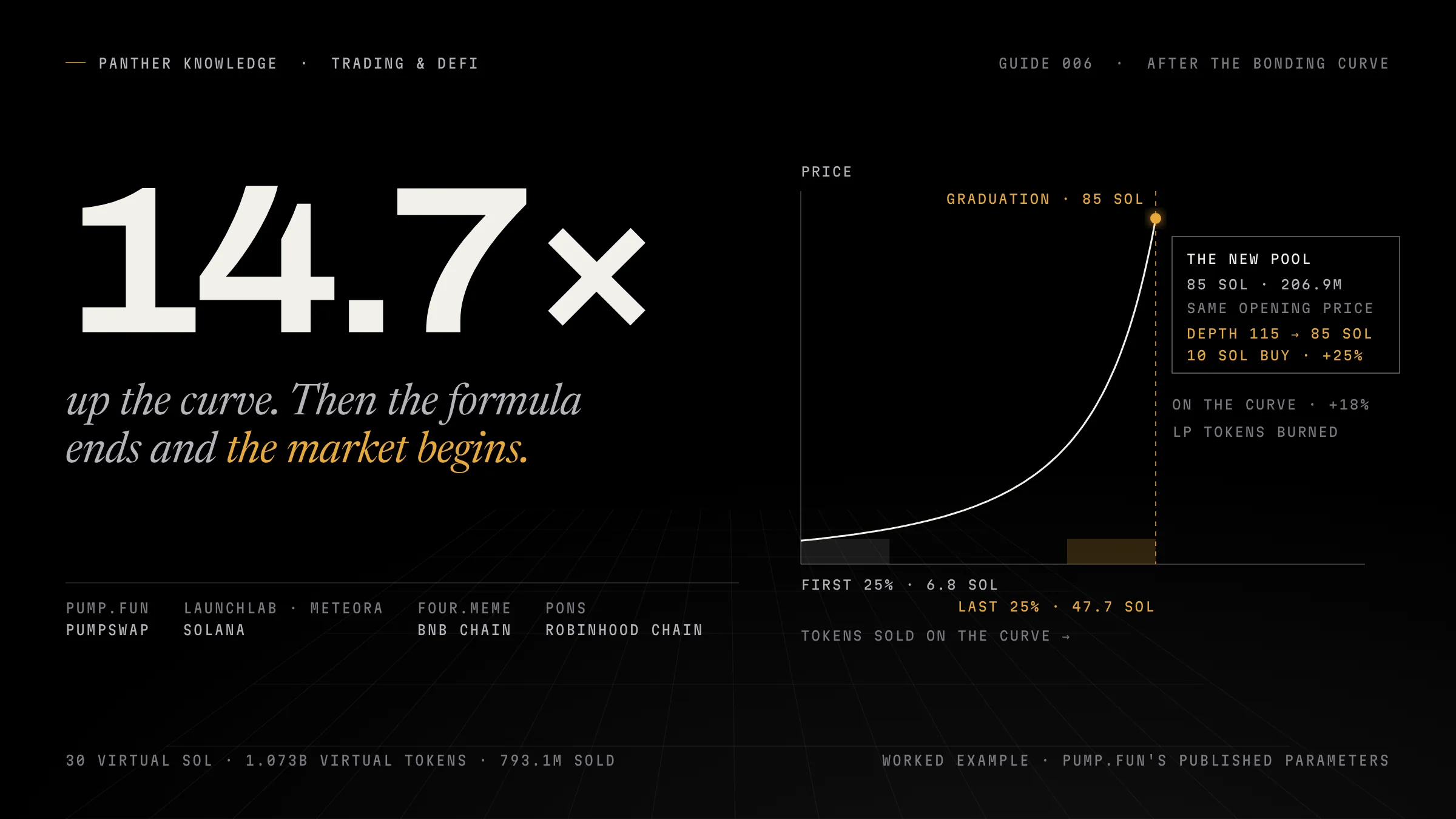
- On a bonding curve the price is a formula of tokens sold. Pump.fun's curve rises 14.7x from launch to graduation, which brings in about 85 SOL.
- The DEX pool is seeded so it opens at the curve's last price. Graduation itself is not a price jump.
- The 30 virtual SOL disappears at graduation: depth falls from 115 to 85 SOL, so the same trade moves the price roughly a quarter to a third more.
- At graduation the average curve buyer holds a 3.8x paper gain, and all curve holders selling at once would get 67 SOL for tokens marked at 326 SOL.
- Fees, token taxes and how market cap is displayed can all change after the switch, and differ by launchpad.
- About 0.6% to 1.4% of Pump.fun coins ever graduate. Graduation means the curve sold out, not that the coin is good.
A memecoin on a launchpad lives two lives. In the first, its price is set by a formula: every buy moves it up a fixed curve, every sell moves it back down. In the second, after it “graduates”, it trades in an ordinary pool on a decentralized exchange, where the price is whatever buyers and sellers make it. People notice the price behaves differently after the switch and assume someone pulled a lever. Usually nobody did. The rules changed, and the numbers explain why.
This guide works through Pump.fun’s published curve parameters on Solana to show what the curve does, what happens at graduation, and the three things that actually change afterwards: how deep the market is, who is holding, and how the price is displayed. It then compares Raydium LaunchLab, Meteora, Four.meme on BNB Chain, Virtuals and Zora on Base, and Pons on Robinhood Chain.
What a bonding curve is
A bonding curve sets a token’s price from how many tokens have been sold: each buy moves the price up the curve and each sell moves it back down. There is no order book and no counterparty: you trade with the curve contract, which quotes a price from how many tokens have been sold so far.
Most memecoin launchpads use the constant-product rule from Uniswap v2, where trades “must not change the product (k) of a pair’s reserve balances.” Pump.fun’s program documentation says its curve “is based on Uniswap V2 and uses synthetic x and y reserves to ensure that there is liquidity for the coin.” The synthetic, or virtual, reserves are the trick: on the first trade there is no real SOL in the curve, but the formula behaves as if there were 30 SOL already in it, so the very first buyer gets a sane price instead of an infinite one.
Pump.fun’s curve, in numbers
The program’s published parameters:
| Parameter | Value |
|---|---|
| Total supply | 1,000,000,000 tokens |
| Sold on the curve | 793,100,000 tokens |
| Held back for the DEX pool | 206,900,000 tokens |
| Virtual SOL at launch | 30 SOL |
| Virtual tokens at launch | 1,073,000,000 |
| Price | virtual SOL ÷ virtual tokens |
The curve is complete when every one of the 793.1 million tokens has been sold; the program sets complete once there are “no more real tokens left in the bonding curve.” Run the constant-product formula with those numbers and the whole path is fixed in advance (fees excluded):
| Tokens sold | Real SOL in the curve | Price (SOL per token) | Market cap in SOL | vs launch |
|---|---|---|---|---|
| 0% | 0 | 0.000000028 | 28.0 | 1.0× |
| 25% | 6.8 | 0.000000042 | 42.1 | 1.5× |
| 50% | 17.6 | 0.000000070 | 70.3 | 2.5× |
| 75% | 37.3 | 0.000000141 | 140.8 | 5.0× |
| 90% | 59.6 | 0.000000249 | 249.5 | 8.9× |
| 100% (graduation) | 85.0 | 0.000000411 | 410.9 | 14.7× |
Pump.fun calculates market cap as “the current price of the token in SOL or USDC multiplied by 1 billion tokens.”
That 85 SOL matches what independent researchers measured. A February 2026 study of Pump.fun found that, during September 2025, graduation corresponded to “approximately 85 SOL raised and a market capitalization of about $69,000.” Pump.fun’s own documentation does not publish a graduation number; its program README says only that liquidity migrates “when the coin hits a certain market cap.” In dollars the threshold moves with the SOL price, which is why you will see $69,000, $100,000 and other figures quoted at different times.
Who paid what
A curve is cheap at the bottom and expensive at the top. Split the 793.1 million curve tokens into quarters:
| Tokens bought | SOL paid | Worth at the graduation price | Paper multiple |
|---|---|---|---|
| First 25% | 6.8 | 81.5 | 12.0× |
| Second 25% | 10.8 | 81.5 | 7.6× |
| Third 25% | 19.7 | 81.5 | 4.1× |
| Last 25% | 47.7 | 81.5 | 1.7× |
| All curve buyers | 85.0 | 325.9 | 3.8× |
At the moment a coin graduates, the average curve buyer is sitting on a paper gain of almost four times, and the earliest on more than twelve. That is the first reason the price behaves differently afterwards: almost everyone holding has a reason to sell.
What happens at graduation
When the curve completes, its liquidity “is migrated to PumpSwap (an AMM on Solana)”, Pump.fun’s own exchange since March 20, 2025; before that, graduated coins went to Raydium. Three details matter:
- The LP tokens are burned. “The LP tokens received from the PumpSwap pool are then burnt,” so nobody can withdraw the new pool. (What burned liquidity does and does not protect.)
- Anyone can trigger it. Migration is a permissionless instruction any user can call once the curve is complete.
- The fee is small now. Pump.fun charges a graduation fee of 0.015 SOL, “deducted from the bonding curve.” It used to be much larger: The Block reported a 1.5 SOL migration fee in August 2024, and the PumpSwap launch announcement in March 2025 advertised “0 migration fees (down from 6 SOL).”
The pool opens at the same price
The new pool is seeded with the curve’s real SOL and the 206.9 million tokens that were never for sale. Divide one by the other and you get 0.000000411 SOL per token, a market cap of 410.9 SOL: the same as the curve’s last price, to within a hundredth of a percent. The parameters are chosen so the handoff is seamless.
Raydium states the same design goal for its own launchpad: the pool’s opening price “is exactly price(base_sold), the marginal curve price at the moment of handoff”, “so an observer switching from the curve UI to the CPMM UI sees no jump.” It also notes the exception: for curves that are not constant product, the handoff price can differ.
Fees taken out at the handoff are the other exception. Where a fee comes out of the SOL that seeds the pool, the pool opens lower. As an illustration on these numbers, removing 6 SOL from 85 opens the pool about 7% below the curve’s final price; at today’s 0.015 SOL the difference is under 0.03%.
So the price does not jump at graduation. What changes is everything around it.
What actually changes after the switch
1. The market gets shallower
On the curve, the price is computed from virtual reserves: at the end, 115 SOL (85 real plus the 30 virtual) against 279.9 million virtual tokens. In the pool there is nothing virtual. As the February 2026 study put it, “the system reclaims the 30 SOL virtual advance used to initialize the curve.” Same price, 85 SOL of depth instead of 115.
The same trade, at the same starting price, on each side of graduation (before fees):
| Trade | On the curve at its final reserves | In the new pool |
|---|---|---|
| Buy with 10 SOL | Price +18.1% | Price +24.9% |
| Sell 10M tokens (1% of supply) | Receive 3.97 SOL, price −6.8% | Receive 3.92 SOL, price −9.0% |
| Sell 50M tokens (5% of supply) | Receive 17.43 SOL, price −28.0% | Receive 16.54 SOL, price −35.1% |
Each trade moves the price roughly a quarter to a third more than it did on the curve. Uniswap’s documentation explains why: “larger trades (relative to reserves) execute at exponentially worse rates than smaller ones.” Smaller reserves, bigger moves, in both directions.
2. The exit is smaller than the market cap
At graduation the curve buyers’ tokens are worth 325.9 SOL at the last price. If all of them sold into the new pool, it would pay out 67.4 SOL in total, and the price would fall about 96% along the way. The pool only ever held 85 SOL. That is the gap between market cap and liquidity, worked through in detail in Market cap vs. liquidity vs. FDV. It is why a freshly graduated coin can drop hard on a few sales without anyone “rugging” anything.
3. Different traders arrive, and some leave
A coin on a curve trades on the launchpad. A graduated coin trades in a public pool that aggregators, trading bots and screeners all see. Two kinds of wallets matter around the switch. Analytics provider Mobula defines a sniper as “a wallet that purchases tokens within the first few blocks (typically 0-3 blocks) after a token launches,” and a bundler as one that “coordinates multiple wallets to buy in the same block or even the same transaction.” Mobula’s documentation also describes snipers buying after 80% bonded as “anticipating Raydium migration momentum”: buying the last stretch of the curve in the hope of a move once the coin reaches a public pool.
4. Fees and taxes can change
On Pump.fun the curve charges 1.25% per trade. The PumpSwap pool for a freshly graduated coin, at around 411 SOL of market cap, sits in its lowest fee tier, “0 – 420 SOL”, which also totals 1.25%; fees step down as market cap grows, to 0.30% above 98,240 SOL. Anyone can also create other, non-canonical PumpSwap pools for the same coin, which charge 0.3%, so one coin can trade in more than one place at slightly different prices.
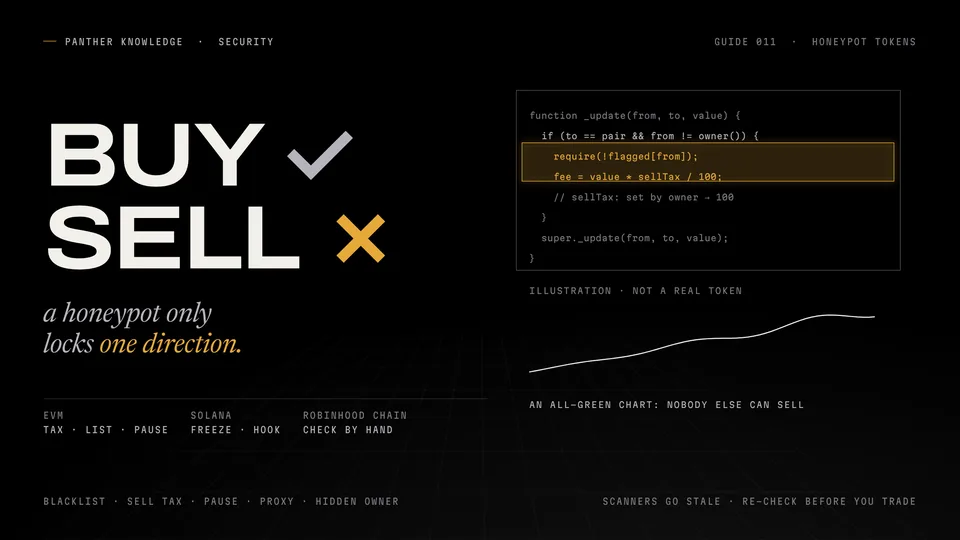
On other launchpads the change can be bigger. Four.meme on BNB Chain lets creators set a tax of 1%, 3%, 5% or 10%, and “Taxes remain active after a token graduates.” Pons on Robinhood Chain says the creator tax “is the one to check before you trade, because it varies from token to token.” A tax the owner can raise after launch is also one of the classic honeypot mechanisms.
5. The number on the screen is calculated differently
Pump.fun quotes market cap as price × 1 billion, in SOL or in dollars at the current SOL price. DEX Screener computes “FDV = (total supply - burned supply) * price,” and shows market cap equal to FDV unless a project has reported a circulating supply. Two screens can show different market caps for the same coin at the same moment, and a dollar figure moves with SOL even when the coin’s SOL price does not.
How other launchpads graduate
| Launchpad | Chain | Curve | Graduates at | Goes to | Pool liquidity afterwards |
|---|---|---|---|---|---|
| Pump.fun | Solana | Constant product, virtual reserves | All 793.1M curve tokens sold (≈85 SOL) | PumpSwap (Raydium before Mar 2025) | LP burned |
| Raydium LaunchLab | Solana | Constant product by default; fixed or linear also allowed | A set SOL target (85 SOL in JustSendit mode) | Raydium CPMM | LP burned; newer launches lock the platform and creator shares |
| Meteora DBC | Solana | Up to 16 constant-product segments | A pre-set quote threshold | Meteora DAMM v1 or v2 | LP locked for partner and creator; at least 10% locked on day one |
| Four.meme | BNB Chain | Bonding curve | ≈18 BNB | PancakeSwap V2 | LP burned |
| Virtuals | Base | Bonding curve | 42,000 VIRTUAL | Uniswap V2 | LP locked for ten years |
| Zora | Base | No separate curve: trades in a Uniswap V4 pool from the start | n/a | n/a | Deposited through the Doppler protocol |
| Pons v2 | Robinhood Chain | Constant product with a “phantom reserve” | 4.2 ETH by default | Uniswap v4 | “Locked and never comes back out” |
Two design choices differ more than the table shows.
Where the migration fee comes from. Meteora takes its migration fee from the quote raised, and builds that into the migration price formula. Raydium deducts swept protocol and creator fees from the pool’s quote reserve. Either way, what seeds the pool is less than what buyers put in.
Sniper protection at launch. Several launchpads tax the first seconds of trading to make sniping expensive: Zora’s “Sniper Tax that decays from 99% over 10 seconds,” Pons’s tax that “starts at 99% of a buy and decays exponentially to zero across the first 5 seconds,” and Virtuals’ tax that starts at 99% and decays to its 1% baseline. These shape who holds the supply before graduation, which shapes who sells after it.
Robinhood Chain: Pons
Pons is a token launchpad on Robinhood Chain (chain ID 4663) with public documentation. Its first version had “no bonding curve and no migration later.” Version 2, reported by Cryptonomist in July 2026 as an “ETH-denominated bonding curve”, works much like Pump.fun:
- “The price is not set by anyone. It is worked out from how much of the supply has been bought so far.”
- A phantom reserve is “a virtual balance that sets the opening price without anyone depositing up front,” the same idea as Pump.fun’s virtual SOL.
- “The entire supply is minted straight to the curve,” but “not all of the supply is for sale on the curve”: a share is held back for the pool.
- At graduation, liquidity becomes “a single full-range position minted at graduation and transferred straight to the locker,” and “is locked and never comes back out.”
Pons’s documentation is also unusually blunt about what graduation means: “Reaching graduation is not a signal of quality. It only means the curve sold out.” Other Robinhood Chain launchpads, such as hood.fun and RobinFun, also run a curve phase before trading in a pool, according to Mobula’s integration documentation.
How many coins graduate at all
Very few. The February 2026 study counted 4,338 graduations out of 655,770 Pump.fun tokens launched between September 1 and October 1, 2025: “about 0.63% in our dataset.” Dune figures cited by Solana Compass in June 2026 put the historical rate at about 1.4%. Graduation is a filter only in the sense that 99 coins out of 100 never pass it. It says nothing about what happens next.
Before you buy around graduation
| Question | Why it matters |
|---|---|
| How far along the curve is it? | The last quarter of the curve costs seven times more SOL than the first; late buyers start with the smallest cushion. |
| How concentrated are holders? | Snipers and bundled wallets that bought early hold paper gains of 10× or more at graduation. |
| How deep will the pool be? | On Pump.fun, about 85 SOL. Compare your position with that, not with the market cap. |
| Is there a token tax, and can it change? | Four.meme and Pons taxes persist after graduation. Read the token, not the launchpad’s headline fee. |
| Is this the canonical pool? | Other pools for the same coin can exist with different depth and fees. |
| Which market cap am I looking at? | Launchpad (price × 1B) and screener (total − burned × price) can differ; dollar figures move with the chain’s coin. |
Sources
- 01Pump program README (curve parameters, migration, LP burn) · Pump.fun on GitHubgithub.com/pump-fun/pump-public-docs/blob/main/docs/PUMP_PROGRAM_README.md
- 02Fee program README (market cap formulas) · Pump.fun on GitHubgithub.com/pump-fun/pump-public-docs/blob/main/docs/FEE_PROGRAM_README.md
- 03Fees · Pump.funpump.fun/docs/fees
- 04Pump.fun bonding curves and graduation, September 2025 sample (arXiv 2602.14860) · arXivarxiv.org/abs/2602.14860
- 05Pump.fun launches PumpSwap: 0 migration fees, down from 6 SOL · Decryptdecrypt.co/310933/solana-pump-fun-pumpswap-exchange
- 06Pump.fun cuts fees; migration fee of 1.5 SOL · The Blockwww.theblock.co/post/310376/pump-fun-cuts-fees-and-unveils-80-incentive
- 07How Uniswap works (constant product, price impact) · Uniswap Docsdocs.uniswap.org/contracts/v2/concepts/protocol-overview/how-uniswap-works
- 08LaunchLab bonding curve (handoff price, fees swept) · Raydium Docsdocs.raydium.io/products/launchlab/bonding-curve.md
- 09LaunchLab (85 SOL in JustSendit mode, LP burned) · Raydium Docsdocs.raydium.io/raydium/pool-creation/launchlab
- 10LaunchLab overview (LP burn and lock after the 2026 upgrade) · Raydium Docsdocs.raydium.io/products/launchlab/overview.md
- 11What is the Dynamic Bonding Curve · Meteora Docsdocs.meteora.ag/overview/products/dbc/what-is-dbc
- 12Dynamic Bonding Curve formulas (migration fee and price) · Meteora Docsdocs.meteora.ag/overview/products/dbc/bonding-curve-formulas
- 13How it works (18 BNB, PancakeSwap pool, 1% fee) · Four.memefour-meme.gitbook.io/four.meme/guide/how-it-works
- 14Product update, March 31 2025 (PancakeSwap V2, LP burned) · Four.memefour-meme.gitbook.io/four.meme/product-update/3-product-update-25-03-31
- 15Introducing tax tokens · Four.memefour-meme.gitbook.io/four.meme/guide/introducing-tax-tokens-on-four.meme
- 16Virtuals launch mechanics · Virtuals Protocolwhitepaper.virtuals.io/about-virtuals/capital-formation-layer/virtuals-launch-mechanics
- 17Coins · Zora Docsdocs.zora.co/coins
- 18Pons v2: bonding curve, graduation, liquidity lock, snipe tax · Pons Docsdocs.ponsfamily.com/docs/v2
- 19Pons documentation (v1) · Pons Docsdocs.ponsfamily.com
- 20Pons API on Robinhood Chain · Bitquery Docsdocs.bitquery.io/docs/blockchain/robinhood/pons-api/
- 21Pons v2 upgrade brings an ETH bonding curve · The Cryptonomisten.cryptonomist.ch/2026/07/23/pons-v2-upgrade-eth-bonding-curve/
- 22Robinhood Chain launchpads: hood.fun · Mobula Docsdocs.mobula.io/almanac/robinhood-launchpads/hoodfun
- 23Detecting snipers and bundlers · Mobula Docsdocs.mobula.io/almanac/detecting-snipers-bundlers
- 24How FDV and market cap are calculated · DEX Screenerhelp.dexscreener.com/en/articles/1146817
- 25Pump.fun launched 42,000 tokens in one day; fewer than 2% reach a DEX · Solana Compasssolanacompass.com/news/pumpfun-launched-42000-tokens-in-one-day-fewer-than-2-will-ever-reach-a-dex
Responses(1)
adil
Woah
Panther Journal — The intelligence brief
Stay ahead of the story.
Free. New investigations delivered when published. Unsubscribe anytime.