Key points
- Judge profitable and losing trades by the same standard: process, evidence and the decisions you controlled.
- Influence does not erase your role in a trade, and personal responsibility does not excuse another person’s fraud.
- A green screenshot is not realized profit, and a falling price alone is not proof of manipulation.
PANTHER JOURNAL #044 · OPINION
In memecoin trading, the candle turns green. You screenshot the profit. You were early. You saw what everyone else missed. You’re a fucking genius.
Then the same position turns red. Suddenly the story changes: someone influenced you, the community misled you, the timeline made you do it.
Same money. Same wallet. Same finger on the button. Somehow, a different explanation for who was in control.
That is one of the dark sides of memecoin trading: the temptation to claim every win and outsource every loss. This is an argument for honest self-assessment—not an excuse for fraud, and not a claim that every trader has the same information or power.
Memecoin trading: your wallet doesn’t have two owners
You’re responsible for your decisions. Both the profitable ones and the stupid ones.
Let’s use memecoins, since this is where so much degen confidence meets so little patience. You see a ticker everywhere. A creator you follow sounds convinced. A group chat celebrates a move you missed. You buy because the next candle feels more urgent than the unanswered questions.
Influence is real. It can shape what you notice, what you believe and what you are willing to risk. But when you knowingly authorize your own trade, that influence does not erase your part in the decision.
If someone’s research helped you profit, acknowledge it. If copying their conviction cost you money, examine your own choices too. Did you check the claim? Did you understand the position? Did you choose the size because it made sense, or because you wanted one trade to fix your life?
Those questions matter on green days as much as red ones.
The ego trades after the trade is over
The easiest post-trade story is the one that protects your pride.
Profit: “I spotted it early.” Loss: “They manipulated me.”
So the brain is yours when you win, but suddenly borrowed when you lose?
There is a useful research lens here. In Simon Gervais and Terrance Odean’s Learning to Be Overconfident, the trader in their theoretical model gives himself too much credit for successes. That biased learning can produce overconfidence and more aggressive trading. It is a model of a mechanism, not a diagnosis of every memecoin trader or proof about any particular token.
The practical question is uncomfortable: did the profitable trade demonstrate a repeatable decision process, or did a weak process happen to get a good outcome?
A win can contain skill, help from others and luck. A loss can contain your mistake, changing conditions and someone else’s misconduct. Honest review leaves room for more than one cause. Your P&L alone cannot settle which explanation is correct.
A green screenshot is not an exit plan
Imagine buying after a persuasive post, watching the position rise and refusing to sell because the chat promises something bigger. Then it falls below your entry.
That example is hypothetical. The questions it raises are concrete. What did you actually realize? What stayed on screen? What information changed? What did you decide to ignore?
A displayed valuation is not the same thing as cash you have received. Panther’s market cap, liquidity and FDV explainer explains why a token’s headline valuation and the liquidity available for exits are different things.
You do not have to call every unrealized gain a missed opportunity. But you do have to stop rewriting your original decision once you know the outcome. “I chose to keep holding” is a more useful starting point than “the profit was stolen from me” when no evidence supports that accusation.
Actual fraud is still actual fraud
Personal responsibility is not a free pass for scammers.
Deceptive claims, fabricated evidence, stolen funds or deliberate schemes deserve investigation on their evidence. A victim clicking a button does not make another person’s deception acceptable. Nor does a profit make dishonest promotion honest.
The SEC’s digital-asset investment-scam alert warns about fraud, FOMO and false profit promises. These risks cannot be waved away with “you should have researched harder.”
At the same time, a falling price does not by itself prove manipulation. A wrong prediction is not automatically evidence of a scheme. Separate what someone promised, what they knew, what they did and what you can substantiate.
If you suspect misconduct, preserve the posts, messages, transaction hashes and timing. Describe the evidence precisely. You can examine your own decisions while still seeking accountability from someone who deceived you. Both can be true.
Review the decision before defending the result
Use the same questions for a profitable trade and a losing one:
- What was my reason? Write down the claim you relied on and what would have shown it was wrong.
- Whose interests did I understand? A promoter may hold tokens, receive compensation or have an exit plan different from yours. Check disclosures instead of assuming alignment.
- What did I authorize? Record the amount, entry, costs and decisions to add, hold or exit. Separate realized results from balances still exposed to the market.
- What could I reasonably verify? Distinguish evidence from confidence, repetition and social proof.
- What will I change? Name one controllable improvement. “Everyone else is an idiot” is not a process improvement.
This is a framework for reviewing decisions, not a promise of profit. The point is to make your next explanation more accurate than your last excuse.
Panther Takeaway
Take the credit. Take the responsibility.
Acknowledge the people who helped you win. Own the choices that helped you lose. Demand evidence before calling a bad outcome manipulation, and never use accountability language to excuse actual fraud.
You don’t get to claim every win and outsource every loss.
Sources and editorial note
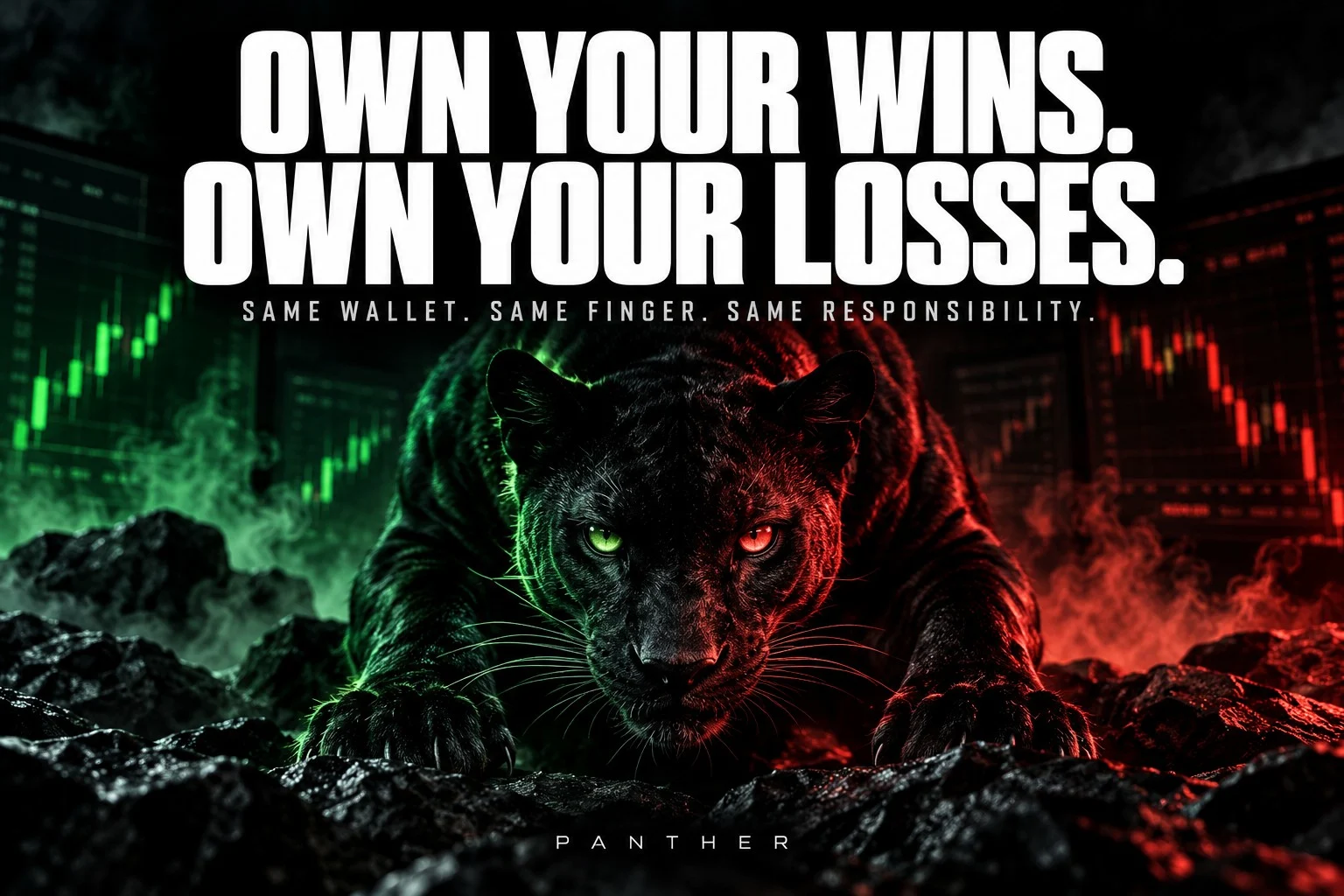
This is Panther’s opinion on trading behaviour, not breaking news, a token recommendation or an allegation against a named person or project. The trading scenes are illustrative. Research context: Gervais and Odean’s theoretical model. Fraud context: SEC investor alert, September 1, 2021. Banner: owner-supplied conceptual illustration; charts are decorative, not market data. Sources checked October 21, 2026.
Responses
No responses yet. Start the conversation.
Panther Journal — The intelligence brief
Stay ahead of the story.
Free. New investigations delivered when published. Unsubscribe anytime.